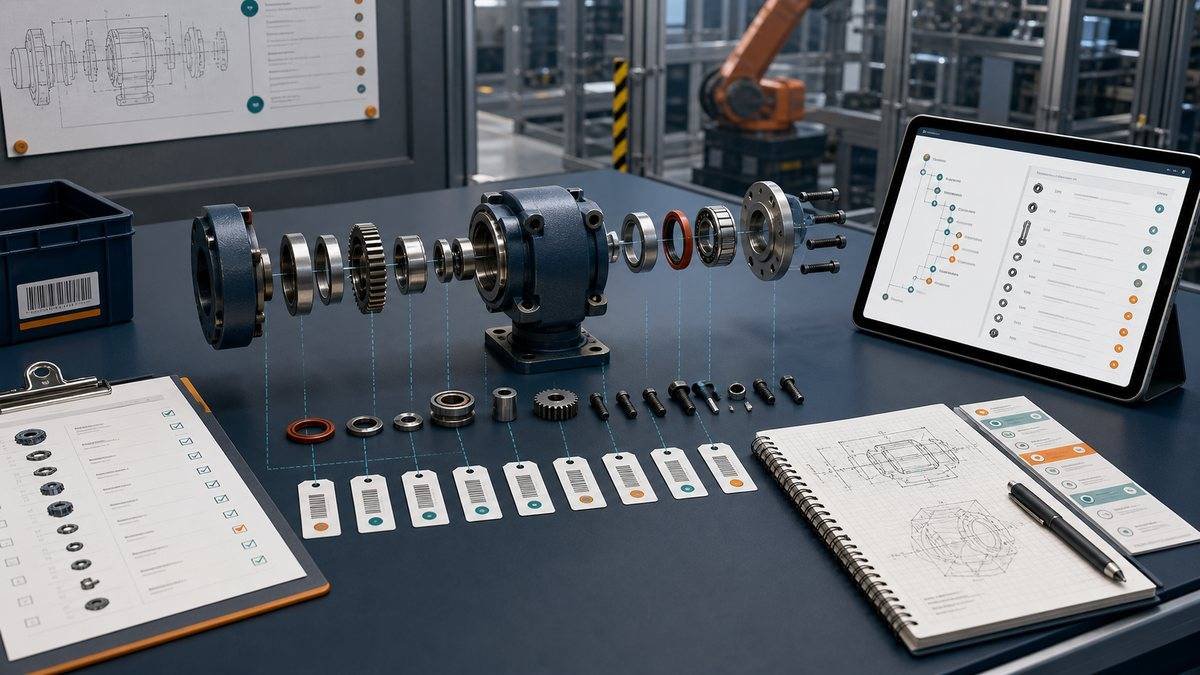
BOM accuracy is the share of bill of materials records that match how the product is really built, verified against the physical assembly. The measurement sounds simple and hides one decision that changes everything: whether you count accuracy per line or per bill. The same audit can report 97% under one convention and 55% under the other, so the denominator has to be declared before the number means anything.
The stakes are mechanical, not rhetorical. MRP multiplies every bill of materials by the production plan; a wrong quantity-per becomes a wrong purchase order on every run, and a missing component becomes a shortage discovered at the line. Inventory record accuracy gets cycle counts and audits in most plants, while the bills feeding the same planning run often go unchecked for years.
What bill of materials accuracy measures
A bill of materials line is accurate when the part number, quantity per parent, unit of measure, and revision all match the current released design and the way production actually assembles the item. Miss any one field and the line is wrong; the error types differ only in how expensively they surface. Logistics glossaries such as Docshipper’s definition describe the same idea as conformity between the documented and the actual product structure.
Verification means comparison against physical reality: build one unit, tear one down, or walk the line with the bill in hand. Comparing the ERP bill against the CAD bill finds transfer errors, and both can share the same mistake; only the shop floor settles what the product truly consumes. The structure being audited here, levels, quantity-per logic, and BOM types, is covered in the companion guide to what a bill of materials is.
The two denominators: per line or per bill
Plants measure bill of materials accuracy under two conventions, and they produce very different numbers from identical audits. Line-level accuracy divides correct lines by total lines audited. Whole-BOM accuracy is all-or-nothing: a bill with one bad line counts as a failed bill.
An illustrative audit makes the gap concrete. Twenty bills are audited, 400 lines in total. Twelve lines are wrong, spread across nine different bills:
| Convention | Calculation | Result | What it rewards |
|---|---|---|---|
| Line-level accuracy | (400 − 12) ÷ 400 | 97.0% | Fixing many small errors anywhere |
| Whole-BOM accuracy | (20 − 9) ÷ 20 | 55.0% | Getting complete bills fully clean |
Neither convention is wrong, and the honest report shows both: 97% of lines are right, and only 55% of bills can be trusted end to end. Planners feel the second number, because a build kits from a whole bill, not from its average. Improvement programs often track line-level for trend and whole-BOM for truth. Whatever target a plant adopts (line-level figures of 98% and up circulate widely as informal practice targets, without an authoritative published source behind them), the convention and the sample size belong printed next to the number.
How to run a bill of materials audit
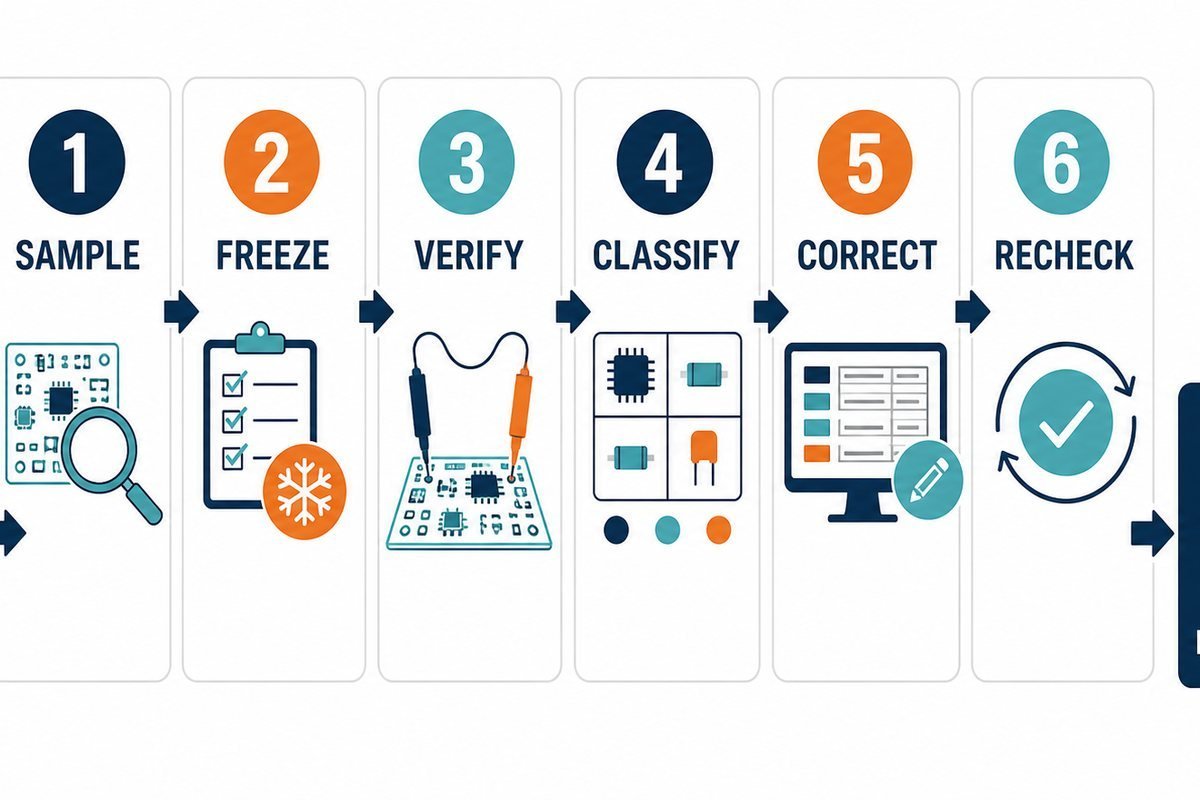
Auditing every bill is neither possible nor necessary. Treat it like cycle counting for structure data: a rolling sample, biased toward the bills where errors cost most.
- Pick the sample by risk. Highest-volume products, recently changed bills, new launches, and anything that generated an unplanned shortage last quarter go first. Add a random slice so stable products still get coverage.
- Audit against the floor, not the file. A planner and a production lead walk one assembly with the released bill: every line checked for part, quantity, unit, and revision; every physical part checked for a line. The second direction catches missing components, which a file-only review never sees.
- Score both conventions. Record errors per line, then roll up per bill. Classify each error by type while standing at the point of use; the classification drives the fix.
- Log the audit like a transaction. Date, auditor, bill revision, findings. Accuracy without an audit trail becomes a number nobody can defend at the next planning argument.
Cadence follows error rate: monthly samples while accuracy is poor, quarterly once bills hold above the plant’s target for two cycles. American Lean’s practical writing on this subject argues for engineering presence on the floor and fast change turnaround as the levers that keep audits from finding the same errors twice, which matches what the error table below assigns as corrective actions.
Common BOM errors: cause, signal, fix, owner
| Error type | Likely cause | Operational signal | Corrective action | Owner |
|---|---|---|---|---|
| Wrong quantity per | Manual entry; design change applied to drawing but not bill | Recurring shortages or excess of one component on every run | Floor verification, correct the line, check where-used for siblings | Manufacturing engineering |
| Missing component | Item added on the floor and never documented | Line-side “grab stock” habits; consumables vanishing unbooked | Reverse-audit assembly vs bill; add the line with routing step | Production + engineering |
| Obsolete revision referenced | ECN released without effectivity discipline | Rework after builds use superseded parts | Tie revision cut-in to inventory run-out dates; purge old revs | Engineering change board |
| Wrong unit of measure | Purchasing UoM confused with consumption UoM | Orders off by a packaging factor (each vs box of 50) | Define conversion on the item master, not per bill | Master data owner |
| Missing or stale scrap factor | Yield never measured or set once and forgotten | Planned quantities always short by a similar percentage | Set factors from measured yield; review with process changes | Manufacturing engineering |
| Phantom flag wrong | Transient subassembly stocked, or stocked item flagged phantom | MRP plans orders for something never built alone, or skips one that is | Match flags to actual stocking policy per subassembly | Planning |
The owner column is the part most improvement programs skip. An error type without a named owner gets corrected one instance at a time forever; the owner’s job is to kill the cause, not the symptom.
Correcting errors without breaking production

The correction loop that holds up in practice runs detect, classify, correct, approve, release, verify, monitor. Three of those steps carry the discipline:
Approve before release. Every bill change moves through the engineering change process (the five gates are laid out in the BOM management process guide), even the obviously right ones. Fast-tracking trivial fixes straight into the ERP feels efficient until two people fix the same bill differently in the same week. Fast and controlled beats informal: a same-day ECN lane for audit findings keeps honesty cheap.
Release with effectivity. A corrected quantity that cuts in mid-kit strands material. Date or serial effectivity, aligned with run-out of existing stock, turns a correction into a non-event on the floor.
Verify after release. Re-audit the corrected bill on its next build. A fix that never gets verified is a hope, and hope reverts: the same floor workaround that created the original error will quietly recreate it if the underlying process did not change.
Why accuracy decays, and what holds it
Bill of materials accuracy is not a project with an end date; it decays at the rate the product changes. Every launch, substitution, and process improvement is a fresh chance for the documented structure and the real one to diverge. Three habits hold the line: audit cadence that never fully stops, error-rate trending by type so systemic causes surface, and a single named owner for structure data, the same role that owns item masters and routings.
The payoff lands everywhere planning data is consumed. Clean bills are a precondition for a reliable master production schedule, and they sit near the top of every data workstream in the ERP readiness checklist, because migrating inaccurate bills into a new system just automates the shortages. Even the demand side depends on it: a manufacturing sales forecast translated through wrong bills produces confident, precise, wrong material plans.
BOM accuracy FAQ
How accurate should a bill of materials be?
Accurate enough that planners stop hand-checking, which in practice means errors are rare at line level and trending down, with the convention and sample size published beside the number. Informal practice targets of 98%+ at line level circulate widely, but no standards body publishes an official threshold; pick a target, declare the denominator, and hold it.
What is a high-level BOM?
A high-level BOM shows only the top of the product structure: the finished item and its major subassemblies, without component and raw-material detail. It suits quoting, early design, and planning discussions; production and MRP need the fully detailed multi-level bill.
Who should own BOM accuracy?
One named role, usually manufacturing engineering or a master data owner, with engineering and production feeding it through the change process. Split ownership is how the same bushing ends up with three quantities in three systems and nobody accountable for any of them.
Next steps
- Audit five bills this month: highest volume, latest change, newest launch, last quarter’s worst shortage, and one at random. Score both conventions.
- Classify every finding against the error table and name an owner per type, not per instance.
- Set the audit as a standing cadence with a same-day ECN lane for findings, and publish the two accuracy numbers with their denominators each cycle.