
Sales and operations planning (S&OP) is a recurring management process that turns demand, supply, product, and financial information into one feasible plan for the business. Its real purpose is not to perfect the forecast. It is to make explicit decisions about what the company will sell, make, buy, stock, and fund when the available choices conflict.
A strong S&OP process gives executives a common set of assumptions and a short list of decisions. A weak one produces a polished deck, several versions of the numbers, and the same shortages or excess inventory next month.
What does sales and operations planning mean?
S&OP means aligning expected demand with the supply, capacity, inventory, and money required to serve it. Teams usually plan at an aggregate level, such as product family, market, or region, so executives can see material tradeoffs without getting trapped in individual order lines.
The process connects several views of the same future:
- Sales and marketing contribute market intelligence, promotions, customer changes, and an unconstrained view of demand.
- Operations and procurement test whether plants, labor, suppliers, materials, and logistics can support that demand.
- Product teams account for launches, phase-outs, substitutions, and lifecycle changes.
- Finance translates the alternatives into revenue, margin, cash, and budget consequences.
- Executive leadership resolves the remaining conflicts and authorizes one plan.
Oracle describes S&OP as both strategic and tactical planning and places its planning horizon at roughly 18 to 36 months. The near term still needs detail, but the executive S&OP conversation should look far enough ahead for the company to change capacity, sourcing, inventory, or commercial priorities before a problem becomes an emergency.
Why S&OP is more than a forecast meeting
A forecast estimates what customers may buy. S&OP decides how the business will respond. If a meeting reviews forecast accuracy but never chooses between overtime, delayed orders, extra inventory, a price change, or a revised sales target, it is demand review rather than a complete S&OP process.
The distinction matters because the most important S&OP inputs are rarely perfectly compatible. Sales may see an opportunity that exceeds available capacity. Operations may prefer a stable production run that builds more inventory than finance wants to fund. Product management may need launch capacity while the existing range is still profitable. S&OP gives those conflicts an owner, a deadline, and a decision forum.
The one-plan test
Ask three questions after the executive review:
- Which demand and supply assumptions were approved?
- Which tradeoffs were decided, by whom, and by what date?
- Do finance, sales, procurement, and operations now use the same approved plan?
If the answers live in separate spreadsheets or depend on another meeting, the process has not yet produced one operating plan. The annoying little clue is often a filename: when every function sends a workbook called “final,” the numbers are probably not final.
What are the six steps of the S&OP process?
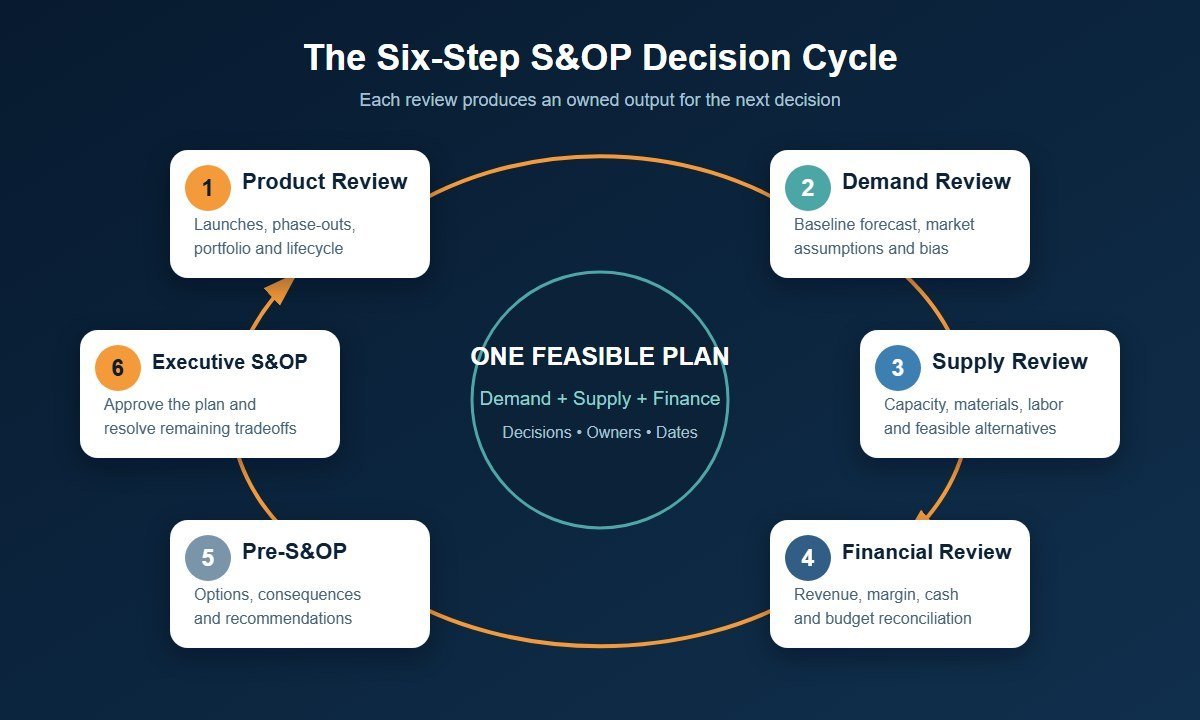
A practical S&OP cycle has six steps: product review, demand review, supply review, financial reconciliation, pre-S&OP, and executive S&OP. Companies may combine or rename steps, but each output must still have a clear owner.
1. Product portfolio review
Product, commercial, engineering, and operations leaders review launches, phase-outs, substitutions, and major lifecycle changes. The output is a time-phased product assumption set: what will enter or leave the portfolio, when it happens, and which resources it consumes.
2. Demand review
Sales, marketing, and demand planning create an unconstrained demand view using history plus current market information. The team should record assumptions separately from the baseline forecast. That makes promotional uplift, a large opportunity, or a customer loss visible instead of burying judgment inside one number.
Forecast accuracy is diagnostic, not a target to defend. Persistent over-forecasting by one region or under-forecasting before every promotion is a forecast bias problem. The demand review should expose that pattern and adjust the assumptions; it should not reward the most persuasive presenter. A step-by-step meeting structure, with inputs, owners, and a 75-minute agenda, is in the demand review process guide.
3. Supply review
Operations, procurement, and logistics test the demand view against labor, equipment, supplier, material, storage, and transport constraints. They produce a feasible supply plan plus alternatives for material gaps: overtime, subcontracting, allocation, inventory build, alternate sourcing, or a change in demand priorities. How to test the plan against capacity and price those options is covered in the supply review guide.
4. Financial reconciliation
Finance compares the operational plan with revenue, margin, cash, and budget expectations. A unit-balanced plan can still be financially unacceptable. Conversely, a profitable sales opportunity may require working capital or capacity that the business has not approved.
5. Pre-S&OP review
Functional leaders reconcile what they can and frame the remaining issues as decisions. A good escalation includes options, consequences, a recommendation, and the latest responsible decision date. Sending raw variances to executives merely transfers analysis upward.
6. Executive S&OP review
The accountable executive approves the plan and decides the unresolved tradeoffs. The meeting should end with documented decisions, owners, due dates, and changed assumptions. Those decisions then feed master scheduling, material planning, purchasing, workforce plans, and financial forecasts.
What is an example of S&OP in manufacturing?
Suppose a manufacturer plans one product family at 10,000 units per month. Sales identifies a promotion that could lift demand to 12,500 units for three months, while normal internal capacity is 11,000. The planning team does not solve that gap by simply changing the forecast.
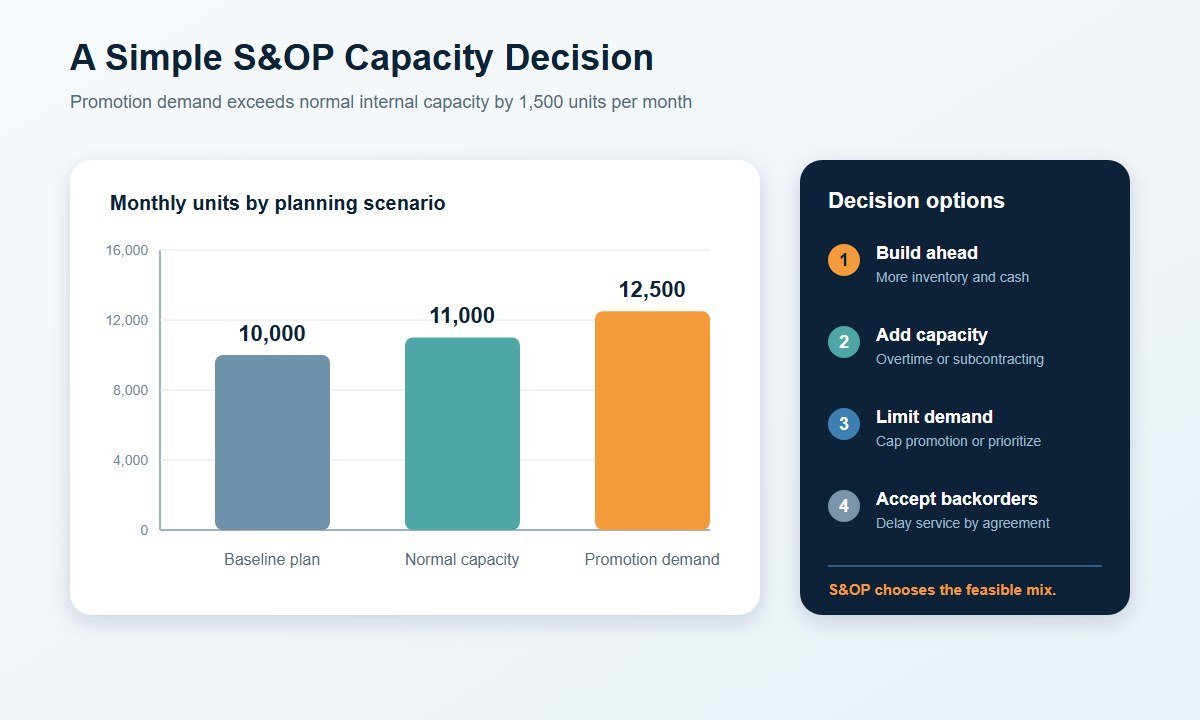
| Option | Operational effect | Decision consequence |
|---|---|---|
| Build inventory before the promotion | Uses earlier capacity and warehouse space | Raises working capital and forecast-obsolescence exposure |
| Use overtime or subcontracting | Adds short-term output | Protects availability but may reduce margin or quality headroom |
| Limit the promotion | Keeps demand closer to feasible supply | Gives up some revenue while protecting service for priority customers |
| Accept backorders | Defers fulfillment | Preserves demand only if customers will tolerate the delay |
Across the three-month promotion, the gross capacity gap is 4,500 units: 1,500 units per month multiplied by three months. The team must close all 4,500 units rather than leave the final quantity implicit.
| Gap-closing decision | Three-month contribution | Owner and control |
|---|---|---|
| Prebuild before the promotion | 1,000 units | Operations releases inventory only against the approved campaign |
| Authorize overtime | 1,500 units (500 per month) | Plant manager monitors labor cost, quality and constraint output |
| Cap the promotion by region | 2,000 units of demand removed or deferred | Sales and marketing restrict offers to the highest-value regions |
| Total gap closed | 4,500 units | Executive S&OP approval |
Finance checks the cash and margin effect, sales resets the commercial commitment, and operations receives an approved volume plan. The example is simplified, but it shows the essential move from “we expect 12,500” to “this is how we will profitably serve the demand we choose to accept.”
How is S&OP different from SCM and IBP?
Supply chain management (SCM) is the wider discipline of designing and operating the flow of materials, information, and products from suppliers to customers. S&OP is one cross-functional planning process within that wider system. SCM includes sourcing, logistics, inventory, manufacturing, and fulfillment activities that continue between planning cycles.
Integrated business planning (IBP) usually extends S&OP by giving finance, strategy, scenarios, and enterprise performance a stronger role. SAP’s S&OP overview also frames the process as cross-functional alignment of demand, supply, and financial planning. In practice, companies use the labels inconsistently. The name matters less than the operating design: one set of assumptions, an explicit financial view, a usable planning horizon, and executives who make decisions.
| SCM | S&OP | IBP | |
|---|---|---|---|
| What it is | The whole discipline of running material, information, and product flows | A recurring cross-functional decision process | S&OP extended with deeper financial and strategic integration |
| Cadence | Continuous daily execution | Monthly cycle, roughly 18–36 month horizon | Monthly to quarterly, often a longer horizon |
| Typical owner | Supply chain organization | General manager or COO | Executive team with finance in a leading role |
| Main output | Delivered orders and running operations | One approved volume and mix plan | One plan tied to financial targets and scenarios |
For vendor-neutral terminology, the ASCM S&OP topic page is a useful reference point maintained by the association behind the APICS body of knowledge.
For a decision framework on when the deeper financial integration is worth adopting, see the S&OP vs IBP comparison.
How can you tell if S&OP is working?
Judge the process by decision quality and plan stability, not by whether every meeting happened on schedule. Useful measures vary by business, but a compact scorecard often includes:
- forecast error and forecast bias at the level where decisions are made;
- customer service, fill rate, or on-time delivery;
- inventory value, days, aging, and obsolescence exposure;
- capacity utilization and constraint adherence;
- expedite, overtime, premium freight, and schedule-change costs;
- revenue, margin, and working-capital performance against the approved plan;
- the number and age of unresolved cross-functional decisions.
Do not optimize one measure in isolation. Extra inventory can improve near-term service while weakening cash flow. A stable factory schedule can hide lost sales. Higher forecast accuracy can be meaningless if teams quietly change the measurement level or exclude difficult items.
Warning signs of a reporting ritual
- Executives attend only when a crisis has already occurred.
- Every function presents its own numbers and no one owns the reconciliation.
- The meeting spends most of its time explaining last month.
- Issues are described, but alternatives and decision deadlines are missing.
- The approved plan does not change purchasing, scheduling, inventory, commercial, or financial actions.
How do you start S&OP without buying new software?
Begin with the decision process. Choose a planning level, horizon, calendar, accountable executive, and a small set of inputs that the business can maintain. The archived Dave Garwood approach to sales forecasting and manufacturing planning offers a useful companion framework for turning the demand input into owned manufacturing decisions. A spreadsheet can support an early process when product families and scenarios are manageable, although version control and scale become serious constraints as complexity grows.
- Define the product families or planning segments.
- Set a rolling horizon long enough to change the important constraints.
- Name one owner for demand, supply, financial reconciliation, and the final plan.
- Run a pilot cycle with actual decisions, not a rehearsal deck.
- Record assumptions, decisions, owners, and dates in one place.
- Improve data and tooling after the team knows which decisions the system must support.
Software can accelerate data collection, scenario analysis, collaboration, and version control. It cannot decide who has authority, force functions to reveal biased assumptions, or make an executive choose between service, inventory, margin, and capacity.
S&OP FAQ
What is the difference between S&OP and demand planning?
Demand planning produces the unconstrained view of what customers are likely to buy. S&OP is the wider process that tests that view against supply and money, then decides what the business will actually commit to. A company can have good demand planning and still fail at S&OP if nobody owns the reconciliation and the decisions.
How long does an S&OP cycle take?
Most companies run the full cycle monthly, with each functional review lasting an hour or two and the executive meeting held on a fixed calendar day. The horizon matters more than the meeting length: the executive conversation should reach far enough ahead — commonly 18 to 36 months — to change capacity, sourcing, or commercial priorities before the options disappear.
Who should own S&OP?
An executive with authority over both commercial and operational functions, typically the general manager, managing director, or COO. Demand review belongs to sales and demand planning, supply review to operations, and reconciliation to finance — but the final plan needs one accountable owner who can decide when those functions disagree.
Is S&OP the same as SOP?
No. SOP usually stands for standard operating procedure, a documented work instruction. S&OP — sales and operations planning — is a management process for balancing demand, supply, and money. The shared acronym causes real confusion in search results and internal documents, which is why this site always writes the planning process as S&OP. A related but distinct term, S&OE, names the weekly execution layer beneath the monthly cycle; the S&OE vs S&OP comparison covers how they connect.
The practical definition of S&OP
S&OP is the discipline of making one feasible, financially understood plan from competing views of demand and capability. The process earns its place when it changes decisions early enough to prevent avoidable shortages, excess inventory, missed launches, and last-minute cost. If the monthly cycle does not produce owners and choices, improve the management design before adding more dashboards.