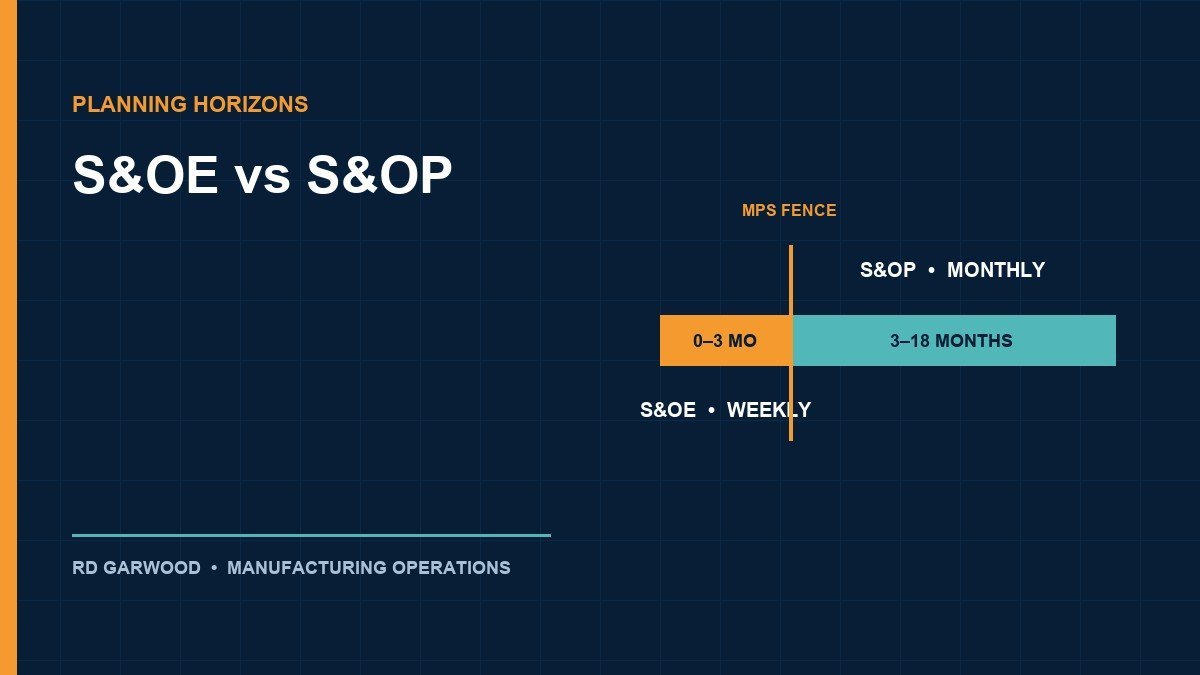
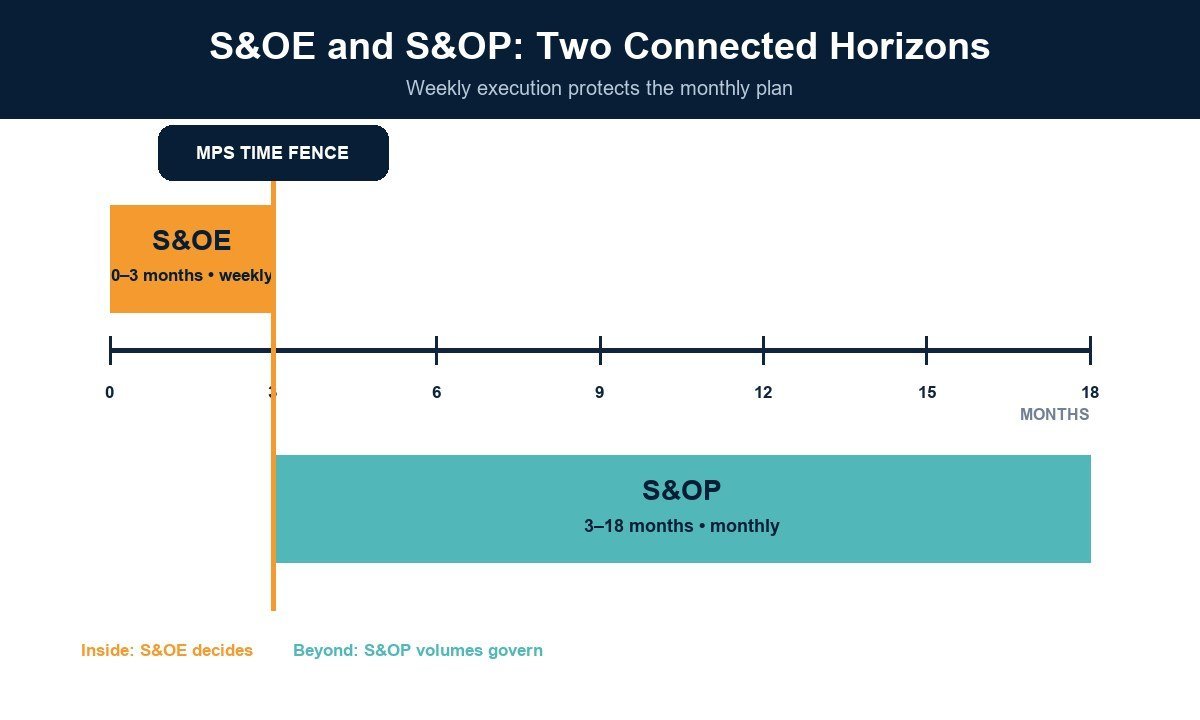
S&OP (sales and operations planning) is the monthly, family-level process that balances demand, supply, and money over a horizon of roughly three to eighteen months and ends in executive decisions. S&OE (sales and operations execution) is the weekly, item-level process that keeps the approved plan on track over the next zero to three months, resolving the shortages, order changes, and capacity hiccups that would otherwise hijack the monthly meeting. S&OP decides what the business will commit to; S&OE keeps that commitment alive week to week.
The vocabulary is younger than the practice. Companies ran short-term execution meetings for decades before the S&OE label appeared; naming the layer matters because it gives the weekly firefighting a defined scope, so it stops leaking upward into the planning meeting and stops going unmanaged in the gaps between meetings.
S&OE vs S&OP side by side
| S&OP | S&OE | |
|---|---|---|
| Horizon | Roughly 3–18 months; some companies extend to 24–36 | 0–3 months, often the next 4–13 weeks |
| Cadence | Monthly cycle | Weekly, sometimes daily for critical items |
| Level of detail | Product family, aggregate capacity | SKU, order, work center, supplier line |
| Core question | What volumes and mix will we commit to, and how will we fund and staff them? | Is this week’s plan still on track, and what do we do about the exceptions? |
| Typical participants | Executives plus demand, supply, finance, product leads | Planners, schedulers, customer service, procurement, logistics |
| Inputs | Consensus demand plan, capacity, financials, scenarios | Open orders, actual demand versus plan, inventory, supplier confirmations, line status |
| Outputs | One approved plan, decisions, owners, funding | Expedite and reallocation actions, short-term schedule changes, escalations |
| Metrics | Forecast error and bias at family level, plan adherence, service, inventory, margin | Order fill, schedule adherence, past-due, short-term forecast realization |
| What it must not do | Chase this week’s late order | Rewrite the monthly plan because one week was noisy |
The last row is the whole relationship. ORI’s explainer on the two processes puts the horizons at three to eighteen months for S&OP and zero to three months for S&OE, and most published descriptions land close to those numbers; the exact boundary matters less than the discipline of keeping each meeting on its own side of it.
Why S&OE got its own name
The layer was named because monthly S&OP kept failing in one predictable way: executives arrived to decide next quarter’s capacity and spent the hour on last week’s shortage. Once execution issues have a weekly meeting of their own, the monthly meeting can look eighteen months out again. The full monthly cycle S&OE protects, from product review through executive decisions, is described in the practical S&OP guide.
ToolsGroup’s discussion of the pair frames S&OE as the mechanism that translates the plan into short-cycle actions and feeds reality back into planning; the framing is right, and it cuts both ways. Without S&OE, the plan drifts unattended between monthly meetings. Without S&OP, S&OE becomes an endless expedite loop with no plan to execute.
A worked example: from monthly plan to weekly exception
The figures below are an illustrative example. In the September S&OP meeting, executives approve October at 11,500 units for a pump family: 10,000 baseline plus a 1,200-unit customer ramp, an 800-unit promotion, and 500 units of distributor destocking, with 500 units of overtime funded to cover a capacity gap. That is the S&OP output: one number, one funded action, owners named.
The weekly S&OE meeting inherits it as roughly 2,875 units a week across four weeks. In week two, actual orders run 3,400 units, 525 above the weekly plan, driven by one distributor pulling forward. S&OE’s job is to answer three questions inside its own horizon:
- Is it a timing shift or new demand? The distributor’s total October order book is unchanged, so week three will run light; net October demand is still 11,500.
- Can week two be served? Yes: pull 300 units of week-three build forward and use 225 units of the funded overtime a week early.
- Does anything need to escalate to S&OP? No, because the monthly total and the funded actions are unchanged. If the distributor had raised its October total to 13,000, that is a change to the plan itself and belongs in the next S&OP cycle, or an interim escalation if it cannot wait.
The escalation rule is the part most companies never write down: S&OE handles anything the approved plan and its funded actions can absorb; anything that changes the monthly total, the mix, or requires new money goes up. Written that way, the weekly meeting stops re-litigating the plan and the monthly meeting stops hearing about individual orders.
Running both without collision
Three practices keep the layers separate in practice. First, different owners: the demand planner and S&OP process owner run the monthly cycle; a master scheduler or supply planner runs the weekly one. The master production schedule is S&OE’s central artifact, and its time fences are where the two horizons physically meet: inside the frozen fence, S&OE decides; beyond it, S&OP’s volumes govern.
Second, different metrics at different levels. Scoring the monthly plan on weekly SKU accuracy makes a sound process look broken; scoring the weekly execution on family-level MAPE hides every fire. The level-and-lag rule from the forecast accuracy metrics guide applies to both, separately.
Third, a written escalation threshold. A simple version: any single change above a stated percentage of the monthly family plan, or any change requiring unfunded overtime, subcontracting, or capital, escalates. Companies with mature planning that are weighing deeper financial integration often find that S&OE discipline is the prerequisite, since the strategic layer described in the S&OP vs IBP comparison only works when execution noise is contained below it.
When a separate S&OE meeting is overkill
A plant with a handful of families, short lead times, and one scheduler who already talks to customer service daily does not need a named S&OE process; the schedule review is S&OE. The formal layer earns its slot when order volume, SKU count, or supplier complexity generates more weekly exceptions than one person can hold in their head, or when the monthly S&OP meeting has visibly become an expedite review. The test is not company size but whether the executives at the monthly meeting are still able to talk about month four.
S&OE vs S&OP FAQ
What is S&OE?
Sales and operations execution (S&OE) is the weekly, item-level process that keeps the approved S&OP plan on track over the next zero to three months. It reviews actual demand and supply against plan, resolves exceptions within the plan’s funded limits, and escalates anything that changes the plan itself.
What are the differences between S&OP and S&OE?
S&OP is monthly, family-level, three to eighteen months out, and produces executive decisions about volume, mix, and funding. S&OE is weekly, SKU-level, zero to three months out, and produces execution actions such as expedites, reallocations, and short-term schedule changes. S&OP sets the plan; S&OE keeps it on track.
What is the difference between S&OP and SIOP?
SIOP (sales, inventory, and operations planning) is S&OP with inventory made an explicit, named decision variable in the monthly balance rather than an outcome. The process steps are the same; the label signals that inventory targets are set deliberately in the cycle instead of falling out of it.
Does S&OE replace S&OP?
No. S&OE executes the plan that S&OP approves; without a monthly plan, the weekly meeting has nothing to execute and becomes a permanent expedite loop. The two run in parallel, connected by a written escalation rule.
Next steps
- Look at the last three monthly S&OP agendas and count how many items were about the current month; if it is most of them, the execution layer is missing.
- Write the escalation rule in one sentence: what S&OE may absorb, what goes up, and who decides.
- Give the weekly meeting its own owner and its own SKU-level metrics, and keep family-level accuracy for the monthly plan.