
ERP readiness is the condition a manufacturer must reach before implementation starts: processes documented and owned, master data trustworthy, people assigned with real time, and governance able to make decisions quickly. The checklist below covers six areas and lives entirely on this page; no form, no download gate. Most published versions sit behind lead-capture forms, which says something about who they were written for.
One framing decision before the list. Readiness is not a score to pass; it is a set of specific gaps, each of which either gets closed before the project or becomes a change order during it. Every unchecked box below has a price, and the price is always lower before the contract is signed. There is no industry-standard passing grade, and any page offering one invented it.
What ERP readiness means for a manufacturer
An ERP system automates the company you actually are, not the one in the sales demo. Readiness work therefore concentrates on the things the software will faithfully amplify: how orders really flow, what the item masters and bills really say, who really makes decisions. Consulting firms that run formal assessments, such as RSM in its guide to ERP readiness assessments, structure them around the same territories: strategy, process, data, people, and governance. The manufacturing-specific weighting below leans harder on master data, because that is where manufacturers bleed.
The six-area ERP readiness checklist
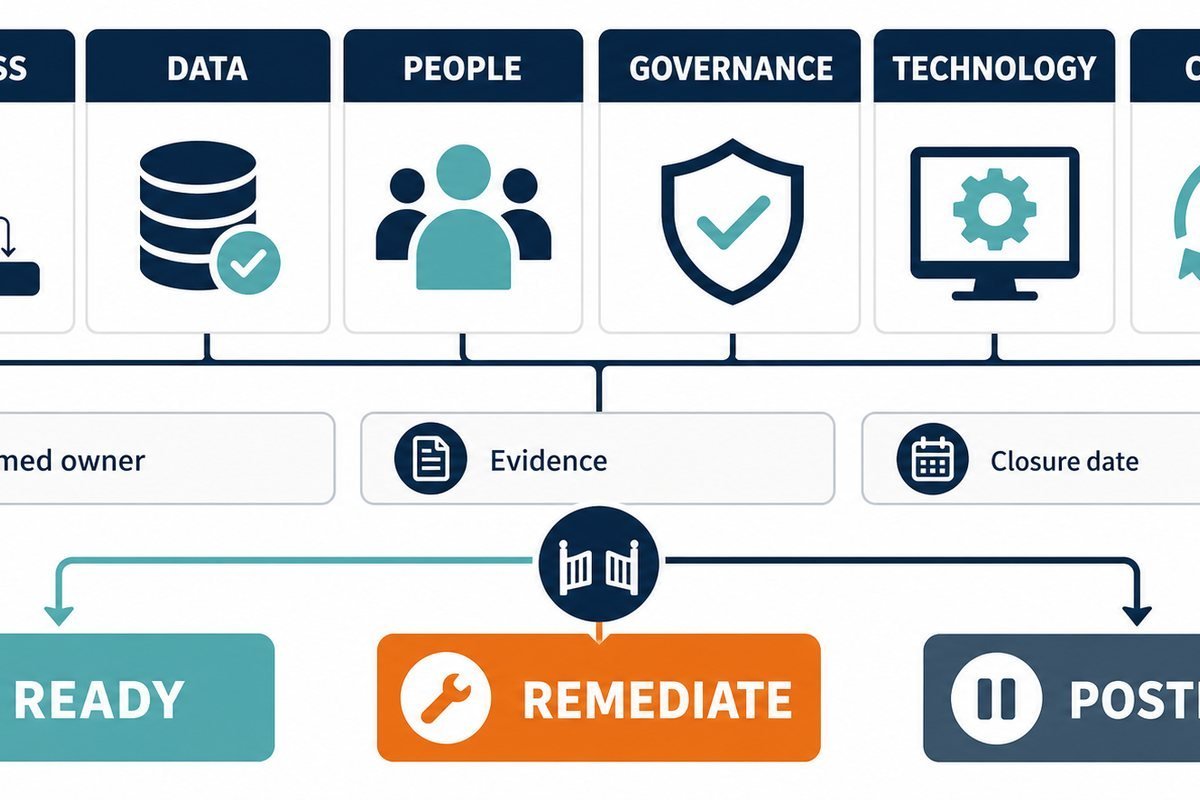
Work through each line; the honest answer is yes, no, or a named gap with an owner. A line answered “mostly” is a no with better manners.
1. Process
- Core order-to-cash, procure-to-pay, and plan-to-produce flows are documented as they actually run, workarounds included.
- Each core process has one named owner with authority to decide how it works in the new system.
- Process pain points are ranked, so the project fixes the expensive ones instead of paving the cow paths.
- Planning processes (forecasting, S&OP, master scheduling) run on a stable cadence today, because a new system speeds up a working process and merely accelerates a broken one.
2. Data
- Item masters are deduplicated, with units of measure and make/buy flags verified.
- Bills of material are complete, revision-controlled, and audited; migrating unaudited bills automates the shortages. The audit method is in the BOM accuracy guide.
- Routings reflect real work centers, times, and yields, not the ones from the last system’s go-live.
- Supplier records carry current lead times and prices; customer records carry current terms.
- Inventory record accuracy is measured by cycle count and trending upward, with a number the warehouse will defend.
- A data owner is named per domain, for cleanup now and for stewardship after go-live.
3. People
- Key users are named for every function, with backfill arranged for a project that will consume real fractions of their time.
- The project has a full-time internal lead, not a department head doing it evenings.
- Shop-floor computer literacy has been assessed honestly; the plan includes training time, not just training slides.
- The people who know where the bodies are buried (the planner with the spreadsheet, the supervisor with the notebook) are on the team, not routed around.
4. Governance
- An executive sponsor owns the project outcome and will personally break ties.
- A steering group meets on a fixed cadence with authority over scope, budget, and dates.
- Decision turnaround is defined: configuration questions get answers in days, not steering-cycle months.
- Scope-change discipline exists on paper before the first change request tests it.
5. Technology
- Current integrations (quality systems, machine data, EDI, e-commerce) are inventoried with owners and data flows.
- Infrastructure basics (network coverage on the floor, barcode hardware, printer mapping) are surveyed before go-live week discovers them.
- Reporting needs are listed from what people use today, including the spreadsheets nobody admits are the real system.
- A data migration path is defined per domain: extract, clean, load, verify, and who signs off each.
6. Change management
- The reason for the change fits in two sentences and the shop floor has heard it from leadership, not from rumor.
- Affected roles know what changes for them specifically; “everything stays the same” is a lie nobody believes anyway.
- Resistance points are mapped, and the loudest skeptic has been given a seat, since converted skeptics make the best champions.
- Go-live support is planned in person-days per department, not as a hotline number.
Evidence, warning signs, and owners

| Readiness area | Evidence of readiness | Warning sign | Owner | Recommended action |
|---|---|---|---|---|
| Process | Documented flows with named owners and ranked pain points | “We’ll define it during implementation” | Operations leadership | Map core flows as-is before vendor selection |
| Data | Audited BOMs, cycle-counted inventory, deduplicated item masters | Planners hand-check the system before trusting it | Master data owner | Run the BOM and inventory audits; publish accuracy numbers |
| People | Named key users with backfill; full-time project lead | Project staffed by whoever is least busy | Executive sponsor | Backfill before kickoff, not after burnout |
| Governance | Sponsor, steering cadence, decision SLA | Configuration questions queue for weeks | Executive sponsor | Set decision turnaround rules in the project charter |
| Technology | Integration inventory; floor infrastructure survey | Integration list discovered during testing | IT lead | Inventory interfaces and hardware in the readiness phase |
| Change management | Two-sentence why; role-level impact map; support plan in person-days | Communication plan equals one kickoff email | Project lead + HR | Map resistance and recruit the loudest skeptic |
Signals you are not ready, and should postpone
Postponing an ERP project is cheaper than rescuing one, and certain conditions predict rescue. Delay the start while any of these holds: master data accuracy is unknown or untrusted and no cleanup is underway; the business is mid-merger, mid-relocation, or mid-leadership-change; the project has no full-time internal lead; the executive sponsor’s calendar has no room for the steering cadence; or the stated goal is “replace the old system” with no ranked list of what must get better. Kilimanjaro Consulting’s readiness checklist makes a similar point from the implementer’s side: the assessment exists to change the start date and scope, not to decorate the business case.
Postponement is not passivity. The highest-return readiness work (data cleanup, process ownership, planning cadence) improves current operations whether or not the project starts on time, which makes it the rare project task with no regret path. A stable planning cycle in particular pays twice: it improves today’s decisions and it defines what the new system must support, a question that also shapes whether the company needs plain S&OP support or the fuller financial integration discussed in the S&OP versus IBP comparison.
ERP readiness FAQ
What is an ERP readiness checklist?
An ERP readiness checklist is a structured review of process, data, people, governance, technology, and change management completed before an implementation begins. Its output is a list of named gaps with owners and dates, which either get closed before kickoff or consciously accepted as project risk.
What are the 4 pillars of ERP readiness?
Most assessment frameworks reduce to four pillars: process, data, people, and governance. Technology and change management extend the four; manufacturers should treat data as first among equals, because item masters, bills of material, and routings are what the new system runs on from day one.
How does readiness relate to the 7 steps of ERP implementation?
Common seven-step implementation models (discovery, selection, planning, design, build and migrate, test and train, go-live and stabilize) all assume readiness work is done or scheduled. Weak readiness does not skip those steps; it stretches the middle ones, which is where budgets go to die.
How long does readiness work take?
It depends on the gaps, and the honest sequence is to measure first: run the data audits and the checklist above, size each gap, then set the ERP start date from the closure plan. Companies that pick the go-live date first and discover the gaps second have chosen their change orders in advance.
Next steps
- Run the six-area checklist in one sitting with the leadership team, recording yes, no, or named-gap per line; forbid “mostly”.
- Start the two audits that gate everything else this month: BOM accuracy and inventory record accuracy, with published numbers.
- Name the executive sponsor, the full-time lead, and the master data owner before talking to any vendor; those three signatures are the real readiness assessment.