
S&OP and IBP share the same monthly decision cycle; the difference is scope. Sales and operations planning balances demand and supply in units over roughly 18 to 36 months, with finance checking the result. Integrated business planning extends that cycle: a longer horizon, full profit-and-loss integration, product portfolio and strategic initiatives inside the process, and scenarios expressed in money as well as units. IBP is not a different meeting; it is the same cycle given a bigger job.
The renaming question generates more consulting revenue than operational improvement, so one position up front: a company that runs S&OP well needs no rebrand to benefit from it, and a company that runs S&OP poorly will run something called IBP poorly too. The useful question is which capabilities are missing and whether they would change decisions, and that question has concrete answers below.
S&OP vs IBP across eight dimensions
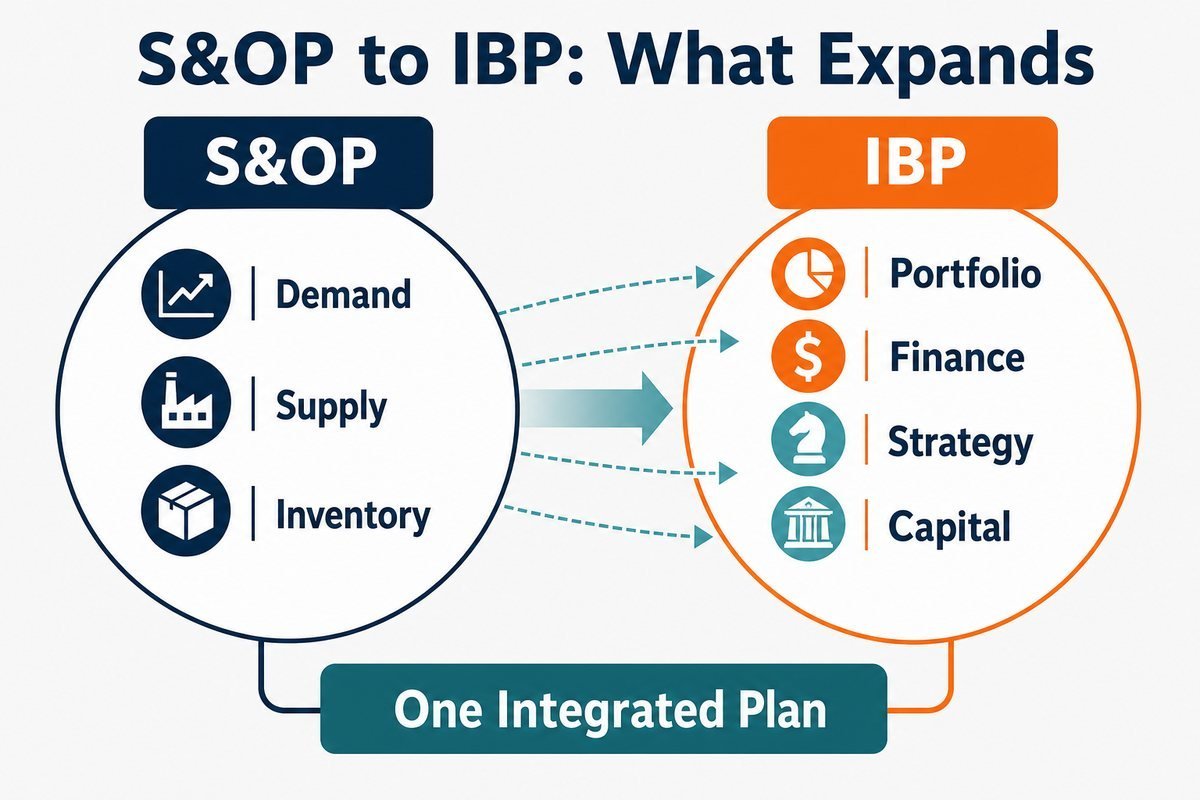
The comparison holds when both processes are run as designed. Terms vary by company and consultant; capabilities are what to compare, not labels.
| Dimension | Classic S&OP | Mature IBP |
|---|---|---|
| Planning horizon | Commonly 18–36 months, weighted to the near half | 24–36+ months, weighted to decisions beyond the budget year |
| Decision scope | Volume and mix: demand, supply, inventory, backlog | Adds portfolio, capital projects, and strategic initiatives |
| Financial integration | Finance reconciles the operational plan | One set of numbers is the financial plan; gaps to budget drive decisions |
| Strategic linkage | Executes the annual plan | Re-tests strategy monthly against latest projections |
| Scenario use | Supply-side scenarios for capacity gaps | Cross-functional scenarios priced in margin and cash |
| Participants | Demand, supply, finance, GM | Adds product management, strategy, and a stronger CFO seat |
| Outputs | One approved volume plan plus exceptions | One plan with P&L view, funded actions, and re-forecast |
| Maturity needed | Works from basic data and discipline upward | Presupposes a stable S&OP cycle and trusted numbers |
Oliver Wight, the firm whose consultants coined the IBP label, describes the relationship the same way in its own comparison: IBP as the evolution of S&OP toward strategic deployment, not a replacement for it. Vendor and consultant pages diverge mostly on how hard they lean on the word evolution; Slimstock’s side-by-side treatment is among the few that also lists what the two share, which is most of the machinery.
What IBP actually adds, in practice

Strip the branding and IBP adds four working capabilities to a solid S&OP cycle. Each is checkable in a meeting, which is a better test than any process diagram:
- Money in the plan, not after it. Every volume scenario arrives with margin and cash impact, so executives choose between financial outcomes, and the monthly output doubles as the rolling financial re-forecast.
- The budget-gap conversation. The gap between the latest projection and the annual commitment is a standing agenda item with options to close it, instead of a surprise in month ten.
- Portfolio inside the cycle. Launches, phase-outs, and capital projects enter the same monthly decision flow that volumes do, sharing one set of assumptions with the demand review and the supply review.
- Horizon past the budget wall. The far months get real attention because the decisions that live there (capacity, sourcing, product) are exactly the ones a 12-month budget view keeps postponing.
None of these requires new software, and none of them is free: each adds preparation work, finance capacity, and executive time. That cost is the honest reason many companies genuinely do not need IBP yet.
Why S&OP fails, and why renaming it does not help
S&OP fails for reasons that have nothing to do with its name: executives delegate the meeting downward until it decides nothing, functions bring competing numbers, the process reports the past instead of choosing the future, and actions leave the room without owners or dates. The full failure catalog is in the practical S&OP guide; every item on it survives a rebrand intact.
The rename-to-IBP move fails the same way for a predictable reason: IBP raises the bar on exactly the disciplines a struggling S&OP lacks. It asks finance to trust numbers that functions still dispute, and asks executives who skip a units meeting to attend a longer one about money. A weak cycle needs its basics fixed (one set of numbers, decision agendas, owners, a respected frozen zone), and those fixes carry no licensing fee and no new acronym.
The third term: S&OE
Sales and operations execution (S&OE) covers the zero-to-three-month window that monthly S&OP deliberately leaves alone: weekly demand-supply balancing, order promising, expedites, and schedule recovery. Companies feeling pressure to make S&OP “more operational” usually need an S&OE layer underneath it, not a strategic layer above it. The weekly cadence belongs to planners and schedulers working the master production schedule; dragging those topics into the monthly executive meeting collapses both.
When to stay with S&OP, and when IBP pays
Stay with S&OP, and invest in running it better, when any of these holds: the monthly cycle still misses decisions or owners; functions still argue about whose numbers are right; demand and supply data still needs manual repair each month; or the executive team already struggles to attend one planning meeting. Maturing the current process beats extending a shaky one, and data readiness work such as the ERP readiness checklist usually returns more than a process rebrand.
IBP starts paying when the boring parts already work and the binding constraint has moved: decisions keep escalating outside the cycle because they need financial framing the process cannot produce; the budget goes stale by spring and steering happens off spreadsheets; portfolio choices and capacity money are decided in separate rooms from volumes; or multi-site trade-offs need margin and cash visibility that a units-only plan cannot give. Two or more of those, with a stable S&OP underneath, is the honest trigger.
Neither answer is permanent. The capabilities stack: a company can add financial integration this year and portfolio integration next, without ever holding a renaming ceremony.
S&OP vs IBP FAQ
Is S&OP the same as IBP?
No, but they are the same family of process. Both run a monthly cross-functional cycle producing one operating plan; IBP extends the scope with full financial integration, product portfolio decisions, longer horizons, and money-denominated scenarios. Many companies run something between the two definitions under either name.
What is the IBP process in S&OP terms?
IBP runs the familiar monthly reviews (product, demand, supply, reconciliation, executive) with wider inputs and outputs: portfolio decisions in the product review, scenarios priced in margin and cash at reconciliation, and an executive meeting that owns the gap between projection and budget. The step structure is recognizably the S&OP cycle.
What are the 6 steps of the S&OP process?
Product portfolio review, demand review, supply review, financial reconciliation, pre-S&OP, and the executive S&OP meeting. The six-step walk-through, with what each step must produce, is covered in the practical S&OP guide linked above.
Next steps
- Score your current cycle against the eight-dimension table honestly, column by column; most companies find they run a hybrid already.
- If two or more IBP triggers apply and the basics hold, pilot one capability first (usually scenarios priced in margin) for three cycles before touching names or tools.
- If the basics wobble, fix decision ownership and one-set-of-numbers first; revisit the IBP question in six months.