
The supply review in S&OP is the step of the monthly cycle where operations tests the consensus demand plan against capacity, materials, and labor, then returns a feasible supply plan plus scenarios for closing any gaps. It sits between demand review and the reconciliation meeting, and it is the only step whose core question is stated in units and hours: can we actually make this?
Almost everything published about this step treats it as one paragraph inside a six-step S&OP overview. That undersells the work. A supply review that only nods at the demand plan produces the same shortages a company would have had with no S&OP at all, one month later and with better slides.
What the supply review in S&OP produces
The supply review receives the consensus demand plan and returns three things: a statement of whether the plan is feasible as demanded, a costed set of options where it is not, and a recommended supply plan for the reconciliation step. It does not decide between expensive options; that decision belongs to executives with the money.
The inputs come straight from the demand review handoff: unconstrained demand by family, the assumption register, sized risks, and allocation priorities. On the supply side, the meeting needs demonstrated capacity by resource, material availability for long-lead items, planned downtime, and current inventory. ASCM’s S&OP topic resources describe this demand-supply balancing as the core mechanism of the process; the supply review is where the balancing stops being a diagram and becomes arithmetic.
Attendees mirror the demand side (how the two roles divide is covered in demand planning vs supply planning): supply planning chairs, with manufacturing, procurement, logistics, and a finance partner in the room. Rockwell’s Plex group, in its S&OP implementation guide, places this step immediately before plan reconciliation for a reason: everything unresolved here lands on the executive agenda.

The rough-cut capacity check
Rough-cut capacity planning (RCCP) converts the demand plan into load on a handful of critical resources and compares it with what those resources can demonstrably produce. The word demonstrated matters: use what the cell produced on real months, not nameplate ratings.
The arithmetic stays deliberately simple. Suppose a machining cell is the critical resource for a pump family, each unit consumes 0.5 machine-hours, and the cell reliably delivers 5,000 machine-hours a month, which is 10,000 units. An October demand of 12,000 units loads the cell with 6,000 hours against 5,000 available: a 1,000-hour hole, visible three months out, while there is still time to do something cheaper than air freight.
Keep RCCP at family level and at the two to four resources that actually constrain the plant. Modeling every work center at SKU level in a monthly review is how the supply review turns into a scheduling meeting; that granularity belongs to the master production schedule and MRP run that execute the plan afterward.
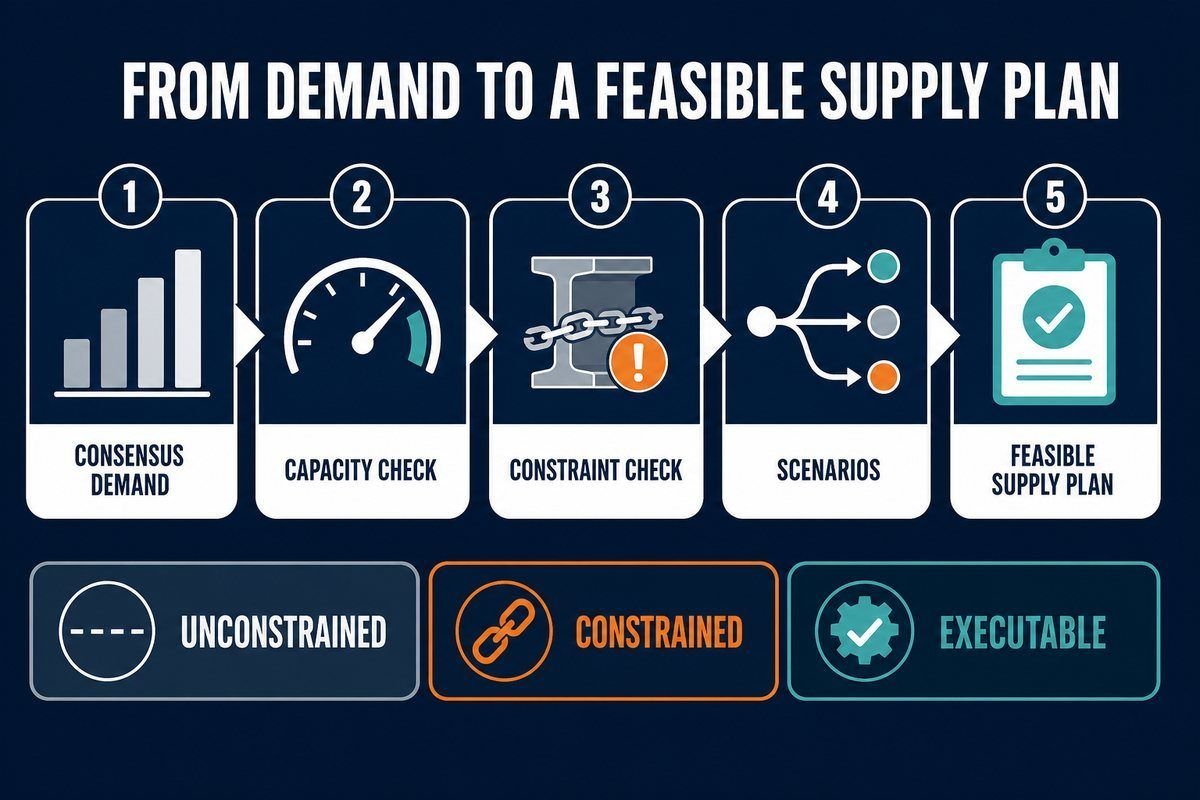
Unconstrained, constrained, and executable plans
Three plan versions run through a supply review, and keeping them separate is most of the discipline:
| Plan version | What it represents | Who owns it | What it must never do |
|---|---|---|---|
| Unconstrained plan | Demand as customers would buy it, no supply limits applied | Demand review | Get quietly trimmed to look feasible |
| Constrained plan | What current capacity and materials can deliver with no new actions | Supply review | Get presented as the only option |
| Executable plan | Constrained plan plus approved actions: overtime, builds, offloads, demand shaping | Reconciliation / executive S&OP | Contain actions nobody has funded |
The gap between the unconstrained and constrained plans is the supply review’s honest output. Erasing it by editing the demand plan hides exactly the information executives are paid to act on, and it is the supply-side twin of the sales team padding its forecast. Both distortions end up as inventory or missed orders; only the department differs.
A worked capacity-gap example with scenarios
The numbers below are an illustrative example built to be recomputed. One pump family, one constraining cell, demonstrated capacity 10,000 units per month, no starting inventory buffer:
| Sep | Oct | Nov | Dec | Total | |
|---|---|---|---|---|---|
| Unconstrained demand | 9,000 | 12,000 | 12,000 | 7,000 | 40,000 |
| Demonstrated capacity | 10,000 | 10,000 | 10,000 | 10,000 | 40,000 |
| Gap (capacity − demand) | +1,000 | −2,000 | −2,000 | +3,000 | 0 |
Annual totals match exactly, and the plan is still infeasible: the shortage sits in October and November while the spare capacity sits in September and, uselessly, in December. Aggregate feasibility is the first illusion a supply review learns to distrust.
Four scenario levers apply, each with a different cost signature:
- Build ahead: run September at full 10,000, carrying 1,000 units into October. Costs working capital and warehouse space; consumes the September slack.
- Overtime: weekend shifts add up to 1,000 units a month at premium labor cost.
- Offload: subcontract machining at a per-unit margin penalty and a qualification lead time that may not fit the window.
- Shape demand: ask the demand side to move volume, such as shifting 1,000 November promotion units into December, where capacity is idle.
One executable combination closes the gap with no subcontracting: build 1,000 ahead in September, run 1,000 units of overtime in each of October and November, and move 1,000 November units to December. Checking every month: October delivers 10,000 capacity + 1,000 overtime + 1,000 from the September build = 12,000, matching demand. November demand drops to 11,000 after the shift and is met by 10,000 + 1,000 overtime. December carries 7,000 + 1,000 moved units = 8,000, inside the 10,000 ceiling. Every row reconciles, which is the standard the supply review’s own output should meet before it asks executives to fund anything.
The recommendation to reconciliation is then one sentence with a price attached: close the 4,000-unit timing gap with an inventory build, two months of overtime, and a promotion shift, at a stated cost, versus the alternative of losing or delaying 4,000 units of October-November sales.
Constraints beyond the machines
Machine hours are the constraint people model first because they are easy to count. The constraints that actually bite in supply reviews are wider, and each needs its own line of questioning:
- Materials: a supplier’s 10-week lead time on one component caps output regardless of machine capacity. If the demand plan added volume inside that window, the units are not buildable at any overtime rate.
- Labor: demonstrated capacity assumes the current crew. A second shift is a hiring and training decision with a lag, not a switch.
- Storage and logistics: a build-ahead scenario that exceeds warehouse space or outbound trucking converts a production fix into a distribution problem.
- Quality and changeovers: squeezing changeovers to gain hours raises scrap risk on exactly the months with no slack to absorb it.
Supplier data quality decides how early the material constraints surface. Plants whose item masters, routings, and bills of material are unreliable discover constraints on the shop floor instead of in the review; that data readiness problem is a core theme of the ERP readiness checklist.
Keeping the review at the right altitude
Two failure patterns account for most weak supply reviews. The first is altitude loss: the meeting descends into this week’s schedule, expedites, and one customer’s late order. Those are execution topics with daily owners; a monthly review that absorbs them stops looking out past the fence, and the three-month-out capacity hole goes unseen until it is a three-week-out crisis.
The second is scenario theater: presenting options without costs or owners. A scenario is only real when it names its price, its decision deadline, and who pulls the trigger. Companies whose planning maturity is being stretched by financial integration questions, where every scenario must carry a margin and cash impact, usually meet that pressure first in this meeting; the S&OP versus IBP comparison covers when that deeper integration pays for itself.
The full monthly cycle this step belongs to, including what happens to unresolved gaps at reconciliation and the executive meeting, is mapped in the practical S&OP guide.
Next steps
To strengthen the next cycle’s supply review:
- Pick the two to four resources that truly constrain the plant and compute demonstrated capacity for each from the last six months of actual output.
- Present unconstrained, constrained, and executable plans as three separate rows every month, even when they happen to match.
- Require every scenario to state units, cost, decision deadline, and owner before it enters the reconciliation deck.