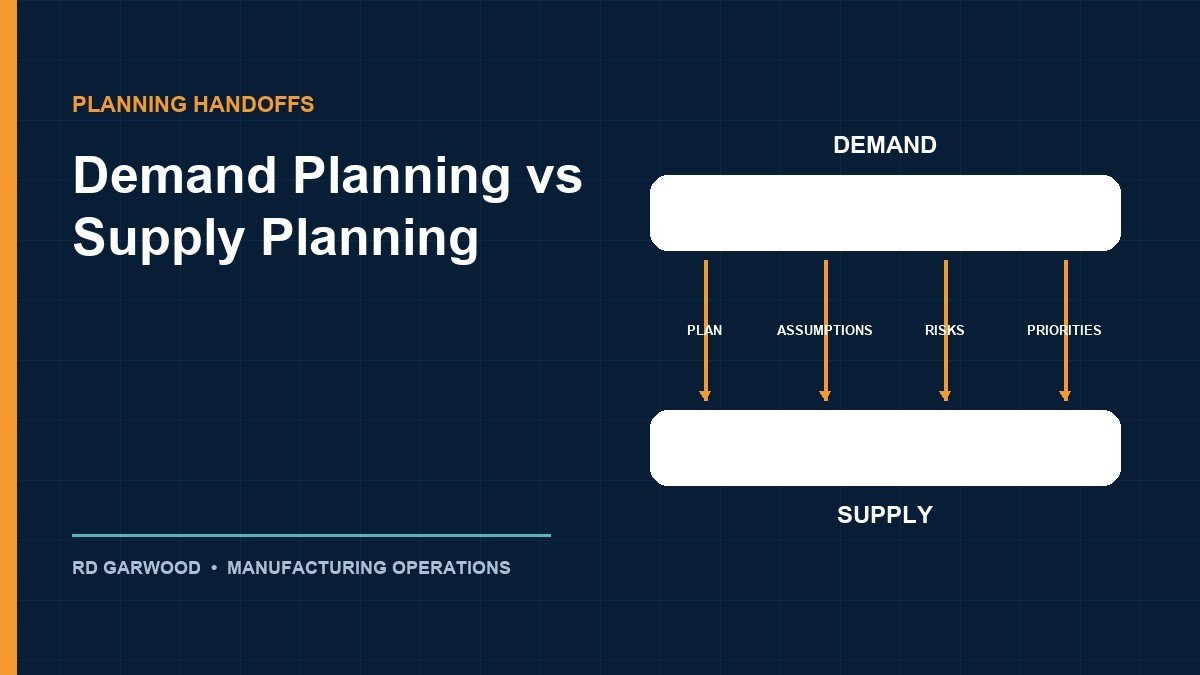
Demand planning estimates what customers will buy and agrees one unconstrained plan across sales, marketing, and finance. Supply planning decides how the company will meet that plan with the capacity, materials, and inventory it actually has. The demand side owns the number; the supply side owns the feasibility. Keeping the two separate, with a deliberate handoff between them, is what makes S&OP work; merging them into one person and one spreadsheet is how the gap between what customers want and what the plant can build disappears from view until it shows up as a stockout.
Most comparisons stop at definitions. The useful part is the seam: what passes from one function to the other, what each is forbidden to change, and what happens when they disagree.
Demand planning vs supply planning side by side
| Demand planning | Supply planning | |
|---|---|---|
| Core question | What will customers buy, by family and month? | Can we build and deliver it, and at what cost? |
| Primary inputs | Demand history, market intelligence, promotions, customer commitments | Consensus demand plan, capacity, material lead times, inventory, supplier commitments |
| Primary output | Unconstrained consensus demand plan plus assumptions and risks | Feasible supply plan plus costed scenarios for closing gaps |
| Constraint stance | Ignores supply limits on purpose | Applies every real constraint |
| Typical owner | Demand planner, reporting to supply chain or commercial | Supply planner or master scheduler, reporting to operations |
| Meeting in the S&OP cycle | Demand review | Supply review |
| Main failure mode | Target disguised as forecast; overrides without owners | Nameplate capacity; quietly trimming demand to look feasible |
| Headline metrics | Forecast error, bias, forecast value added | Plan adherence, capacity utilization, service level, inventory |
ASCM’s overview of demand and supply planning draws the same boundary: demand planning anticipates and shapes what will be needed, supply planning ensures the business can meet it. Everything below is what happens at the line between those two sentences.
Why demand planning ignores supply on purpose
The demand plan is unconstrained by design, and the design is not naive. If planners trim the forecast to what the plant can build, the gap between real demand and real capacity never gets written down, so nobody prices the overtime, the subcontract, or the lost sale. The whole point of separating the functions is to make that gap visible and expensive-looking early, when there is still time to do something cheaper than expedite.
A practitioner in an r/supplychain thread put the resulting tension bluntly:
“Sales celebrate with a golf tournament and I struggle with how to expedite 300% a suppliers capacity in a month.”
– r/supplychain, July 2026 (26 upvotes)
That complaint is exactly what a working handoff prevents. A 300% demand spike should arrive at supply planning as a flagged risk with an owner months earlier, not as a purchase order the week it lands. The mechanics of building that unconstrained plan, with owners and expiry dates on every override, are covered in the guide to what demand planning is.
The handoff: four things that cross the line
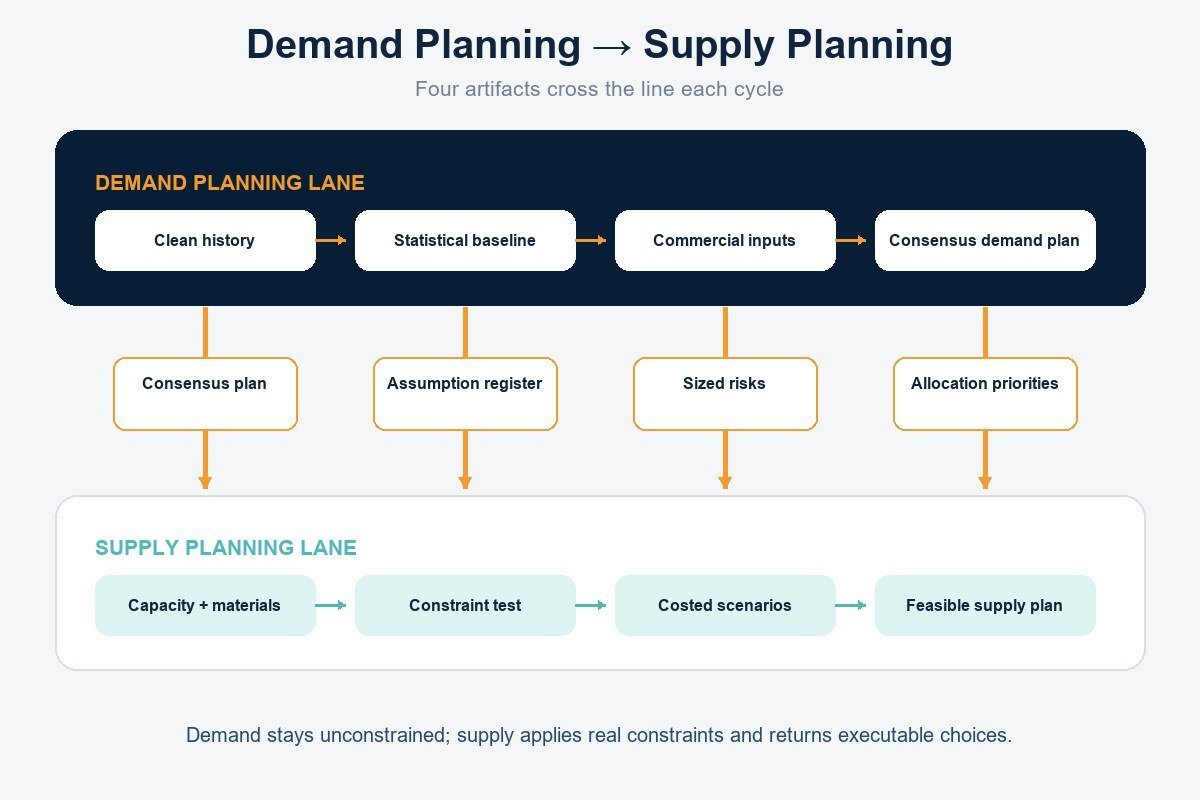
Supply planning cannot do its job on a single column of numbers. Four artifacts pass from demand to supply each cycle, and the demand review is not finished until all four exist:
- The consensus demand plan, frozen and versioned, by family and month.
- The assumption register: every override with its owner, size, confidence, and expiry, so supply planners know which demand is firm and which is hope with a date on it.
- Sized risks: upsides and downsides in units, so buffers and hedges can be priced against something specific.
- Allocation priorities: which customers or segments win if the plan cannot be fully served.
The fourth is the one most companies skip, and its absence surfaces weeks later as an argument between a scheduler and an account manager, held without the data either needs. Supply’s return delivery is symmetrical: the constrained plan, the executable plan with approved actions, and the list of demand it cannot serve. What supply planning does with the four inputs, from rough-cut capacity checks to costed scenarios, is the subject of the supply review guide.
One cycle, both sides, with the arithmetic
The figures below are an illustrative example. A pump manufacturer plans one family for October:
| Step | Owner | Units | What changed |
|---|---|---|---|
| Statistical baseline | Demand planning | 10,000 | Cleaned history, modeled |
| Consensus demand plan | Demand review | 11,500 | +1,200 ramp, +800 promotion, −500 destocking |
| Constrained supply plan | Supply planning | 11,000 | Cell demonstrated capacity, no actions |
| Executable plan | Executive S&OP | 11,500 | 500 units overtime approved at stated cost |
The gap of 11,500 − 11,000 = 500 units is the entire reason the two functions stay separate. Demand planning did not shave 500 units off to make the plan fit; supply planning did not pretend the cell could do 11,500. The gap went to the executive meeting with a price on it, and the business chose overtime over turning away demand. Had the two roles been merged, the likeliest outcome is a consensus of 11,000 that nobody remembers deciding, and 500 units of lost sales nobody ever counts.
Where the two overlap, and where people confuse them
The functions share the same product hierarchy, the same planning calendar, the same frozen versions, and the same S&OP cycle, and the demand-planning.com comparison of supply versus demand planning makes the fair point that both roles are ultimately about getting people to commit to numbers that will be partly wrong. Where they blur in practice:
- Inventory targets. Demand planning supplies the variability that safety stock is sized against; supply planning sets and holds the stock. Both claim it; supply owns it.
- New products. Demand planning forecasts the launch curve; supply planning decides how much to pre-build against a forecast everyone knows is shaky. The launch risk belongs on the demand register, the pre-build decision on the supply side.
- Demand shaping. Moving a promotion to a slack month is a supply-side scenario that only the demand side can execute, which is why it belongs in the executive meeting rather than in either review alone.
The confusion that costs most is treating “supply planning” as a synonym for the master schedule. Supply planning is the family-level, monthly, decision-oriented layer; the master production schedule is the item-level, weekly execution of what supply planning approved.
Can one person do both?
In a small manufacturer, often yes, and the risk is not workload but honesty. One planner wearing both hats will, without noticing, start forecasting what the plant can make. The safeguard is procedural rather than organizational: publish the unconstrained number and the constrained number as two separate rows every month, even when the same person produced both. If the two rows are identical twelve months running, either the plant has infinite capacity or the demand plan is being trimmed before it is written down. Larger organizations split the roles for the same reason, and then face the opposite failure, where the two planners stop talking and the handoff decays into an emailed spreadsheet.
Demand planning vs supply planning FAQ
What is the difference between S&OP and demand planning?
Demand planning is one input to S&OP; S&OP is the monthly management process that balances the demand plan against the supply plan and financial targets, then has executives decide the trade-offs. Demand planning produces the unconstrained number; S&OP decides what the company will actually commit to.
What are the main differences between demand planning and supply planning?
Five practical differences: the question asked (what will sell vs can we build it), the constraint stance (unconstrained vs fully constrained), the primary output (consensus demand plan vs feasible supply plan), the owning function (commercial-facing planner vs operations-facing planner), and the metrics (forecast error and bias vs plan adherence and service level).
Which comes first, demand planning or supply planning?
Demand planning comes first in every cycle, because supply planning needs the unconstrained demand plan as its input. The order reverses only for the feedback: supply planning returns the constrained plan and the unserved demand, and that feedback shapes next month’s demand priorities.
What does a demand planner do that a supply planner does not?
A demand planner cleans history, builds the statistical baseline, collects and challenges commercial overrides, and chairs the consensus meeting. A supply planner converts the agreed plan into capacity and material requirements, identifies constraints, builds scenarios, and recommends the executable plan. The demand planner faces the market; the supply planner faces the plant and suppliers.
Next steps
- Check whether the four handoff artifacts exist in your process; most companies pass only the first and discover the missing priorities during an allocation argument.
- Publish unconstrained and constrained demand as two rows every month, whoever produces them.
- Route every demand-supply gap to the executive S&OP meeting with a price attached, and never resolve it by editing the demand plan.