
The demand review process is the monthly cycle in which sales, marketing, and demand planning turn a statistical baseline into one agreed, unconstrained demand plan. The meeting at its center, usually called the demand consensus meeting, exists to make decisions about assumptions and risks, and it fails whenever it becomes a forecast presentation instead.
Most published guidance on this topic describes what a demand review is and stops before the operational details: which inputs must arrive before the meeting, who owes them, what the agenda looks like minute by minute, and what the supply team needs to receive afterward. Those details are the difference between a consensus process and a calendar invite, so they get the space here.
Where the demand review process sits in the S&OP cycle
The demand review is the second step of the classic monthly cycle described in the sales and operations planning guide: after product review, before supply review, financial reconciliation, and the executive meeting. Its output feeds everything downstream, which is why a weak demand review quietly degrades the entire cycle.
Oliver Wight, the firm whose consultants formalized much of this process, frames the demand review as the point where the commercial team reaches consensus on time-phased actions to influence and generate demand. Two words in that framing carry the load. Consensus means one set of numbers everyone will defend. Actions means the meeting decides things, and a demand review that ends without a single changed assumption or assigned action was a status update.
Plan at the level the horizon supports. Near months need SKU or item-family detail; months nine through eighteen belong at category level, where the conversation is capacity and money. Writing in IBF’s Journal of Business Forecasting, S&OP practitioner Tania Bustos recommends exactly this tiered aggregation by planning horizon: weekly-SKU-customer one month out, widening to quarterly-category-channel at nine months.
What must arrive before the meeting, and who owes it
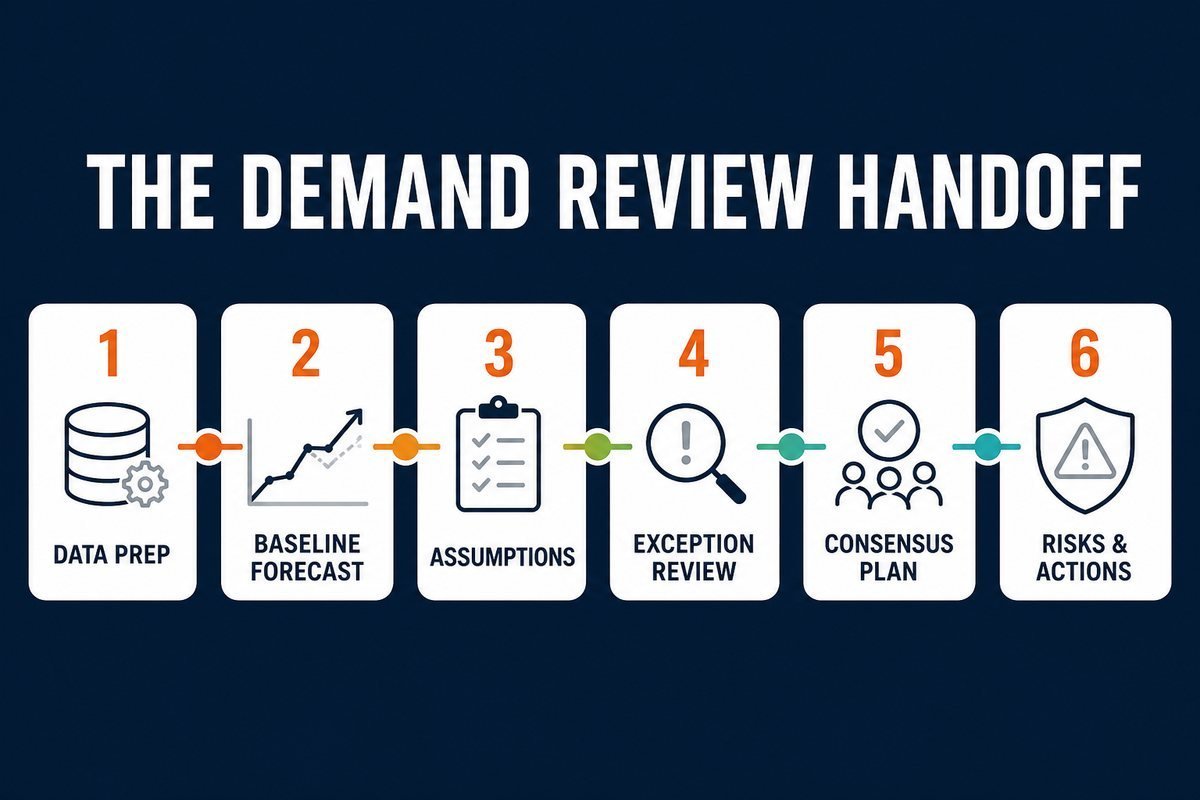
A demand consensus meeting runs on five inputs, each with a named owner and a deadline measured in working days before the meeting. When one of them is missing, the meeting spends its decision time reconstructing data instead.
| Input | Owner | Review question it answers | Output it produces | Due |
|---|---|---|---|---|
| Cleaned demand history | Demand planner | What did customers actually want, net of stockouts and one-time events? | Corrected baseline history | D-5 |
| Statistical baseline forecast | Demand planner | What does history alone predict, before judgment? | Baseline by family, frozen and versioned | D-4 |
| Sales intelligence | Account managers | Which customers will behave differently, and by how many units? | Named overrides with reason and expiry | D-3 |
| Marketing calendar | Marketing lead | Which promotions, launches, and phase-outs change the shape of demand? | Time-phased uplift and transition assumptions | D-3 |
| Exception list | Demand planner | Which items broke error or bias tolerance last cycle? | Short agenda of items needing discussion | D-2 |
The exception list deserves its own defense. Reviewing every SKU is how demand reviews swell past two hours and lose their managers; Bustos reports sitting through reviews that ran over an hour per category for exactly this reason. The meeting reviews deviations: items whose error or forecast bias broke tolerance, plus items carrying new assumptions. Everything else moves on the baseline without discussion.
Overrides need structure at intake, before anyone debates them. An override with no expiry date becomes a permanent distortion; one with no owner cannot be challenged; one with no stated reason cannot be scored later. The intake rule is one line: no owner, no reason, no expiry, no override.

A 75-minute demand consensus meeting agenda
This agenda fits a mid-size manufacturer planning eight to fifteen product families on a monthly cycle. Attendees: demand planner (chair), sales manager, marketing lead, finance representative, and the S&OP process owner. Plant schedulers are welcome as listeners; supply constraints stay out of scope by design, because this meeting states what demand is, and the supply review decides what to do about it.
| Minutes | Segment | What happens | Decision produced |
|---|---|---|---|
| 0–10 | Last cycle scorecard | Error and bias by family at the frozen lag; overrides scored against what happened | Which assumptions failed and get retired |
| 10–20 | Baseline walk-through | Planner shows the new statistical baseline and what changed since last month | Baseline accepted as the starting point |
| 20–45 | Assumptions and overrides | Each named override defended by its owner: units, timing, confidence | Override accepted, resized, or rejected |
| 45–60 | Exceptions and risks | Items off tolerance; upside and downside scenarios sized in units | Risk list with unit ranges and owners |
| 60–70 | Consensus call | Chair reads the resulting plan by family; disagreements resolved or escalated | One unconstrained demand plan |
| 70–75 | Actions and handoff | Actions assigned with dates; handoff package confirmed for supply review | Action list; handoff released |
Two timing rules protect the agenda. The scorecard opens the meeting because accountability for last month’s assumptions changes how boldly people assert this month’s. And the consensus call gets its own segment near the end; folding it into the assumptions debate produces meetings where everyone discussed everything and agreed to nothing specific.
Consensus is a decision, not an average
Consensus in a demand review means every function commits to operate from the same numbers, including the functions that argued for different ones. It does not mean the meeting splits the difference. Averaging a sales override of 1,400 against a baseline of 1,000 to land at 1,200 satisfies nobody and encodes no assumption; either the customer ramp is real and defensible, or it is not yet.
The chair’s job is productive tension. The questions that create it are concrete: Which customer, which month, how many units? What happened the last time this account promised a ramp? If this launch cannibalizes the current product, where is the negative override that pays for the positive one? Bustos’s version of this list includes checking pending orders, discontinued items still in the revenue plan, and cross-SKU cannibalization, and her broader point stands: the chair manufactures the questions that expose weak assumptions before the plan absorbs them.
Bias in the room has a predictable shape because incentives do. Sales teams whose consensus number becomes their quota argue low; marketing teams protecting a launch argue high. Both patterns are visible in the scorecard within three cycles if overrides are scored by owner, which is the strongest argument for doing so; the formal method for that scoring is forecast value added. The mechanics of measuring that drift, including the sign conventions that trip up dashboards, are covered in the forecast accuracy metrics guide.
One warning from practice: do not let the budget gap set the forecast. The gap between consensus demand and the annual budget belongs on one slide, stated in units and revenue, and then it belongs to the executive S&OP meeting. Closing it by inflating the demand plan converts a commercial problem into an inventory problem.
What the supply review needs from you
The supply review needs four artifacts from the demand review: the frozen consensus plan, the assumption register, the sized risk list, and priority guidance for allocation. Shipping all four complete is the demand review’s definition of done:
- The consensus demand plan: unconstrained units by family by month, with the version stamped and frozen.
- The assumption register: every active override with owner, size, confidence, and expiry, so supply planners know which demand is firm and which is hope with a date on it.
- The risk list: upsides and downsides sized in units, so capacity buffers and material hedges can be priced against something specific.
- Priority guidance: which customers or segments win if the supply review finds the plan cannot be fully served.
The fourth artifact is the one most demand reviews skip, and its absence surfaces three weeks later as an allocation argument between a scheduler and an account manager, held without the data either needs. Ten minutes of priority discussion in consensus beats that argument every month.
When a separate demand review is overkill
A stand-alone demand consensus meeting earns its slot when there are enough families, enough overrides, and enough people that assumptions genuinely conflict. A twenty-person manufacturer with one planner and a sales director does not need it; a thirty-minute demand segment inside the monthly S&OP meeting does the same work with less ceremony. The test is not company size but assumption volume: once overrides regularly number more than a handful, or sales and marketing start contradicting each other in the hallway instead of a meeting, the separate review pays for itself. Organizations evaluating whether their planning process needs deeper financial integration face a similar staging question, covered in the comparison of S&OP and IBP.
Demand review process FAQ
What is a demand review?
A demand review is the monthly S&OP step in which sales, marketing, and demand planning agree on one unconstrained demand plan. It combines a statistical baseline with named commercial assumptions, reviews last cycle’s accuracy, and hands a consensus plan plus risks to the supply review.
What are the 4 components of demand?
Planners commonly decompose demand into base demand, seasonal or cyclical patterns, trend, and event-driven demand such as promotions or one-time projects. The decomposition matters in a demand review because each component gets forecast differently, and overrides should name which component they claim to change.
How is a demand review different from demand planning?
Demand planning is the continuous work: cleaning history, maintaining models, managing overrides. The demand review is the monthly decision meeting that work feeds. A company can run excellent demand planning and still hold poor demand reviews, because the review adds something the planning work cannot: cross-functional commitment to one number.
Who should attend the demand consensus meeting?
The demand planner as chair, a sales leader empowered to commit their team, the marketing lead who owns promotions and launches, a finance representative, and the S&OP process owner. Keep it under eight people; every seat beyond the decision-makers converts decision time into presentation time.
Next steps
To install this in one cycle:
- Publish the inputs table with owners and D-minus deadlines, and hold one dry run where missing inputs are named out loud.
- Adopt the override intake rule immediately: no owner, no reason, no expiry, no override.
- Run the 75-minute agenda twice before tuning it; most complaints about the structure disappear once the scorecard segment starts retiring failed assumptions.