An engineering bill of materials (EBOM) describes the product as designed: parts grouped by function, straight from the CAD model. A manufacturing bill of materials (MBOM) describes the same product as built: parts regrouped by assembly step, with packaging, consumables, and process materials added that no drawing shows. Same product, same parts, different structure, and the difference is what MRP, purchasing, and the shop floor consume. Running production on the EBOM plans the right parts at the wrong stations and quietly omits everything the design never needed to mention.
The question underneath most searches for this comparison is not what the two are but whether a given company needs both. That gets a direct answer below, including the case for staying on one bill.
EBOM vs MBOM side by side
| EBOM (engineering BOM) | MBOM (manufacturing BOM) | |
|---|---|---|
| Describes | The product as designed | The product as built |
| Organized by | Function and CAD assembly hierarchy | Assembly sequence and work station |
| Created by | Design engineering | Manufacturing engineering, from the EBOM |
| Lives in | CAD / PLM | ERP / MRP |
| Contains | Designed parts, quantities, reference designators, revisions | Everything in the EBOM plus packaging, labels, adhesives, consumables, phantom subassemblies, scrap factors |
| Omits | Anything not on a drawing | Design-only groupings that do not match how the plant builds |
| Consumed by | Engineering change, drawings, design reviews | MRP, purchasing, work orders, costing, shop-floor kitting |
| Changes when | The design changes | The design changes, or the process changes with no design change |
Rootstock’s comparison of the BOM types and PTC’s digital-thread framing both land on the same core distinction: the EBOM is the design record, the MBOM is the production record derived from it. The last row of the table is the one that decides whether a company needs both, and it gets its own section.
One product, two bills: an illustrative example
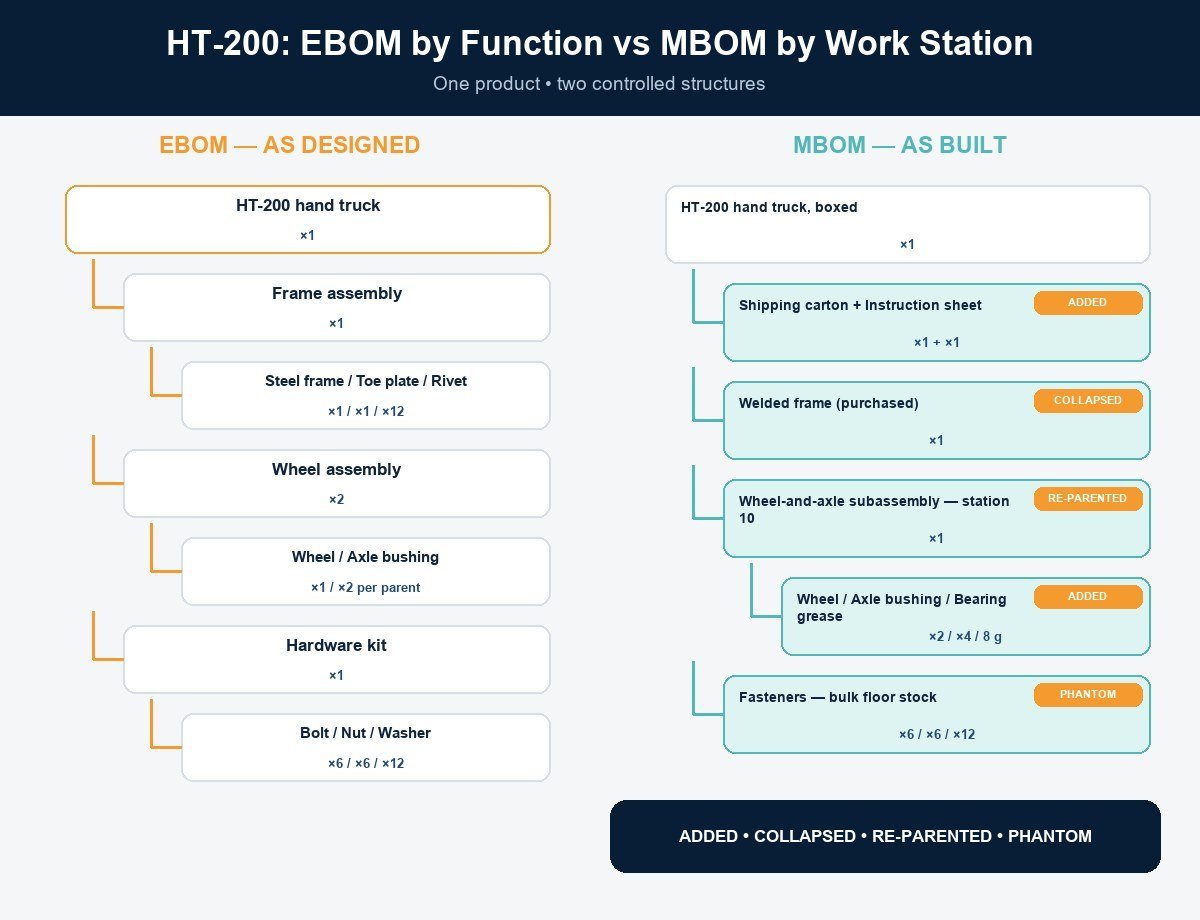
The hand truck below is invented for this illustration. Its EBOM, straight from the CAD tree, groups parts by function:
| EBOM level | Part | Qty per parent |
|---|---|---|
| 0 | HT-200 hand truck | 1 |
| 1 | Frame assembly | 1 |
| 2 | Steel frame | 1 |
| 2 | Toe plate | 1 |
| 2 | Rivet | 12 |
| 1 | Wheel assembly | 2 |
| 2 | Wheel | 1 |
| 2 | Axle bushing | 2 |
| 1 | Hardware kit | 1 |
| 2 | Bolt / nut / washer | 6 / 6 / 12 |
The plant does not build it that way. Frames arrive welded from a supplier, wheels are pressed onto axles at one station, final assembly happens at another, and the truck ships boxed. The MBOM regroups the same parts by that sequence and adds what production actually consumes:
| MBOM level | Part | Qty per parent | Change from EBOM |
|---|---|---|---|
| 0 | HT-200 hand truck, boxed | 1 | Packaged item is the sellable unit |
| 1 | Shipping carton | 1 | Added: not on any drawing |
| 1 | Instruction sheet | 1 | Added |
| 1 | Welded frame (purchased) | 1 | Frame + toe plate + rivets collapsed to one bought part |
| 1 | Wheel-and-axle subassembly (station 10) | 1 | Two wheel assemblies re-parented under one station-level parent |
| 2 | Wheel | 2 | Quantity rolled up to the new parent |
| 2 | Axle bushing | 4 | 2 × 2, rolled up |
| 2 | Bearing grease (grams) | 8 | Added consumable |
| 1 | Fasteners (bulk floor stock) | 6 / 6 / 12 | Hardware kit made phantom; issued from bin, not kitted |
Count the differences: three lines added that no engineer drew (carton, instruction sheet, grease), three lines collapsed into one purchased part, two assemblies re-parented under a station with quantities rolled up (2 × 2 = 4 bushings at the new level), and one subassembly turned phantom so MRP issues fasteners from floor stock instead of building a kit. Every one of those changes is invisible in the EBOM and load-bearing in the MBOM. Run MRP on the engineering view and the plant orders zero cartons, plans rivets it never installs, and generates work orders for a hardware kit nobody assembles.
More complete formats, including an electronics bill with reference designators and a costed roll-up, are in the bill of materials examples. The BOM structures themselves, including levels, quantity explosion, and the seven BOM types, are covered in the guide to what a bill of materials is.
Do you actually need two bills?
Not always, and the honest answer depends on one variable more than any other: how often the process changes independently of the design. A practitioner in an r/MechanicalEngineering thread on exactly this question described the single-bill trade-off from experience:
“The last company I worked for used a single BOM. Lots of stress on the engineers to fix little BOM problems and to organize the BOM by manufacturing intent rather than engineering intent. Maybe not ideal, but the other option risks the eBOM and mBOM getting out of sync. Maybe not an issue for a slow paced company, but for that company I worked for, we made pretty fast iterations.”
– r/MechanicalEngineering, December 2025 (10 upvotes)
That captures both failure modes. One bill forces engineers to maintain manufacturing detail they do not own; two bills can drift apart. The decision rule that resolves it:
- Stay on one bill when the product is simple, the plant builds roughly the way the design is grouped, and process changes are rare. Add the packaging and consumable lines to the single bill and accept that engineers see them.
- Split into EBOM and MBOM when the plant regroups parts by station, buys subassemblies the design shows as parts, adds many process materials, or changes routings and suppliers without any design change. At that point, one bill means every process tweak becomes an engineering change, or the bill stops being maintained.
- Whichever you choose, keep one link. Every MBOM line traces to an EBOM line or is explicitly flagged as manufacturing-added, and every engineering change triggers an MBOM review. That traceability, not the number of bills, is what prevents drift.
The scale where a split becomes hard to avoid is roughly the point where a spreadsheet stops working: overlapping revisions, shared parts across many products, and where-used questions that take hours. The migration signals are the same ones listed in the ERP readiness checklist.
Keeping EBOM and MBOM in sync
Drift between the two bills is a change-control problem, so the fix is procedural. Every engineering change order carries an MBOM impact step: manufacturing engineering confirms which MBOM lines change, which added lines are affected, and whether the station grouping still holds. Process-only changes (a new supplier for the welded frame, a different grease) go through the same loop as MBOM-only changes with no EBOM revision. The five-gate change process, effectivity dating, and the two rules that keep it honest are laid out in the BOM management process guide.
The audit that catches drift is the same one that measures accuracy: sample bills against the physical build, and classify each mismatch as EBOM error, MBOM error, or sync failure between them. The method and its two accuracy conventions are in the guide to bill of materials accuracy.
EBOM vs MBOM FAQ
What is the difference between an engineering BOM and a manufacturing BOM?
The EBOM lists the product as designed, grouped by function from the CAD model. The MBOM lists the same product as built, regrouped by assembly step and expanded with packaging, consumables, purchased subassemblies, and phantom items. Engineering owns the EBOM; manufacturing engineering derives and owns the MBOM; MRP runs on the MBOM.
What are the differences between an MBOM and an SBOM?
In manufacturing, SBOM usually means the service bill of materials: the replaceable parts and service kits needed for repair and aftermarket support, which omits non-serviceable internals the MBOM contains. In software, SBOM means software bill of materials, a component inventory for security compliance, an unrelated document that shares the acronym.
What is the difference between an EBOM and an MBOM in SAP?
SAP distinguishes them by BOM usage: an engineering/design usage bill for the EBOM and a production usage bill for the MBOM, both against the same material master. Other ERPs use similar flags or separate BOM types. The mechanism differs by system; the distinction it encodes is the one described above.
What are the two types of BOM processing?
Explosion and implosion. Explosion walks down the bill to compute component requirements for a finished-goods quantity, which is what MRP does against the MBOM. Implosion, or where-used, walks up from a component to every parent that consumes it, which is what change control depends on for both bills.
Next steps
- Take one product and list every item production consumes that is not on the engineering drawing; if the list is long, the MBOM already exists in someone’s head and should exist in the system.
- Decide one bill or two using the process-change-frequency rule, and write the decision down with its reasoning.
- If two, add an MBOM impact step to every engineering change order this month and audit five bills for sync.