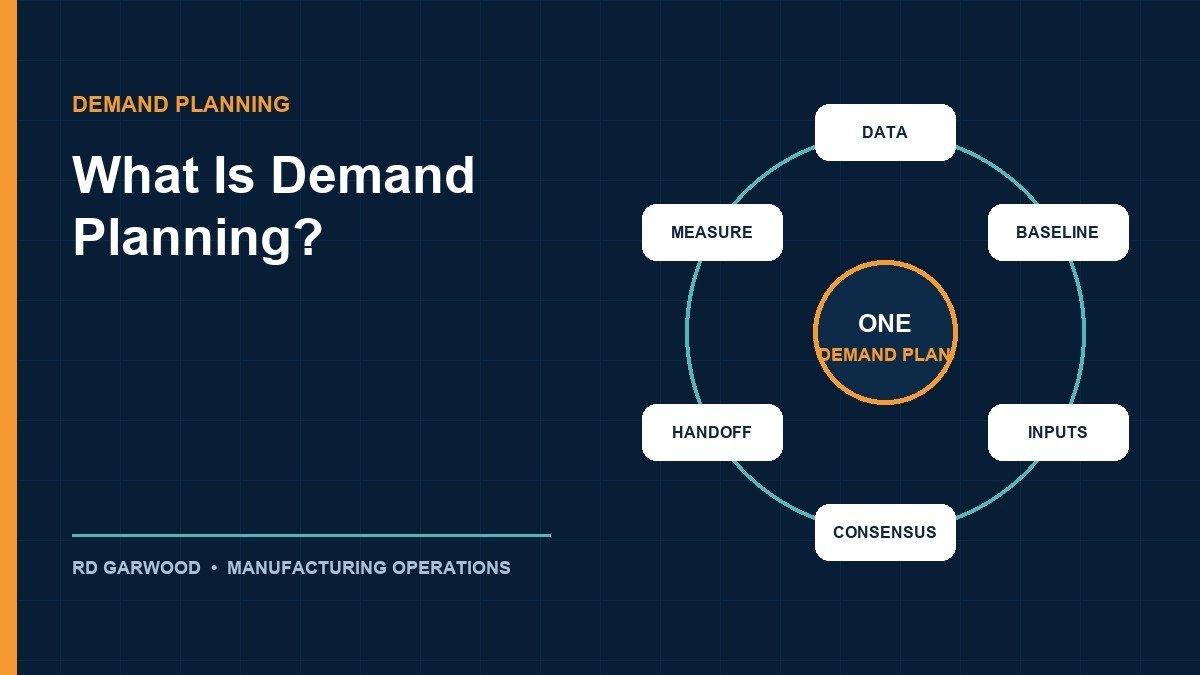
Demand planning is the cross-functional process of building one agreed forecast of what customers will buy, then using it to drive supply, inventory, and financial decisions. It combines a statistical baseline from demand history with commercial intelligence from sales and marketing, reconciles the two into a consensus demand plan, and hands that plan to supply planning and S&OP. Forecasting produces the number; demand planning turns the number into commitments the business will act on.
The distinction matters because most companies that say they do demand planning actually run a forecasting spreadsheet with a monthly argument attached. What follows is the working definition, the six-step process, a manufacturing example with real arithmetic, and the boundaries where the discipline stops.
Demand planning vs demand forecasting
Demand forecasting is the analytical step: applying models and judgment to history and market data to estimate future demand. Demand planning is the management process wrapped around it: choosing what to forecast and at what level, collecting assumptions from the people who know the market, agreeing one number across functions, and measuring the result so next month’s plan improves. IBF’s glossary defines the output, the consensus forecast, as the single forecast agreed by the functions that must live with it, which is why “consensus” appears in every serious description of the discipline.
A short test separates the two in practice. If a planner can produce the number alone at a desk, that is forecasting. If the number cannot be finalized until sales, marketing, and finance have each put an assumption on the record and someone has adjudicated the conflicts, that is demand planning.
The demand planning process in six steps
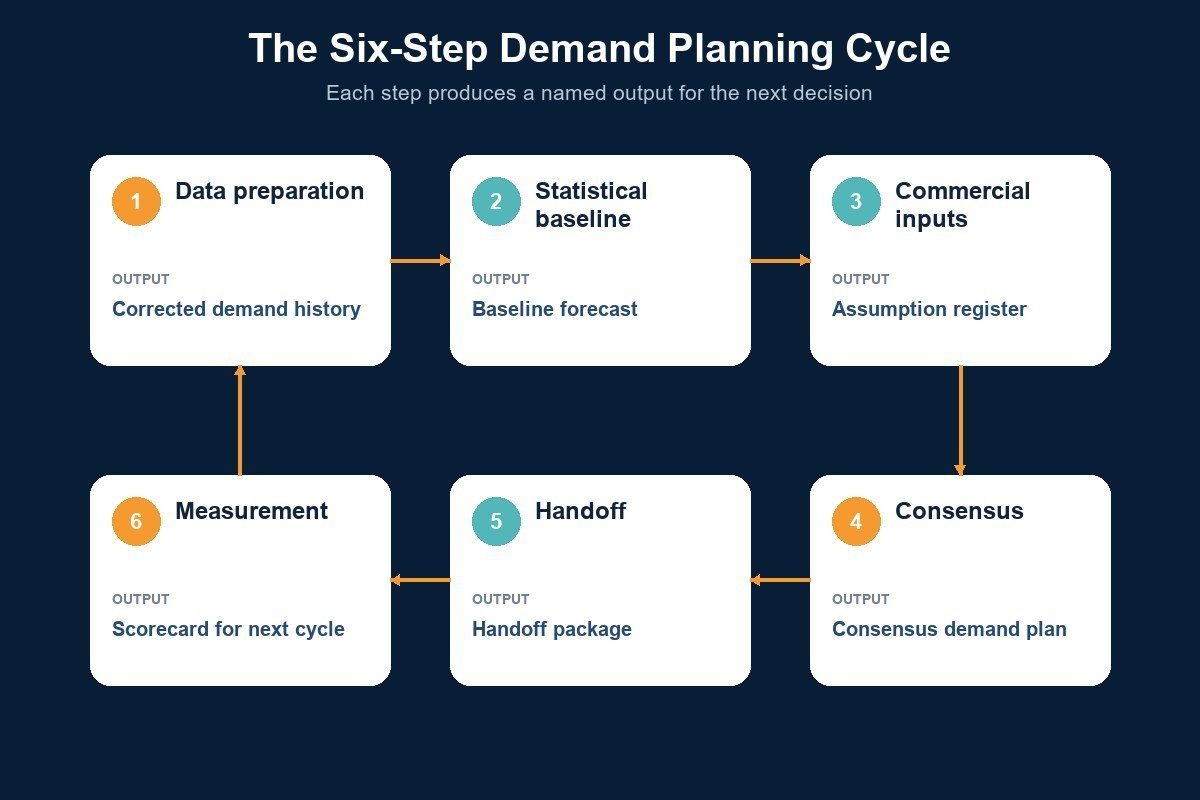
The monthly cycle below is the version most manufacturers converge on. Each step produces a specific output that the next step consumes:
| Step | What happens | Output | Owner |
|---|---|---|---|
| 1. Data preparation | Clean shipment history into true demand: correct stockouts, returns, one-time orders | Corrected demand history | Demand planner |
| 2. Statistical baseline | Model the cleaned history at family or item level, frozen and versioned | Baseline forecast | Demand planner |
| 3. Commercial inputs | Sales and marketing add named overrides: promotions, account changes, launches | Assumption register | Sales, marketing |
| 4. Consensus | Functions reconcile baseline and overrides into one unconstrained plan | Consensus demand plan | Demand review chair |
| 5. Handoff | Plan, assumptions, risks, and priorities pass to supply planning | Handoff package | Demand planner |
| 6. Measurement | Score error, bias, and value added by step at the frozen lag | Scorecard for next cycle | Demand planner |
Step 4 is where the discipline earns its name, and it is the step most often skipped or faked. How to run it as a decision meeting rather than a presentation, with inputs, owners, deadlines, and a 75-minute agenda, is covered in the guide to the demand review process. The IBF-affiliated primer Demand Planning 101 frames the same cycle from the planner’s seat and is a fair companion read.
A manufacturing example with the arithmetic shown
The numbers below are an illustrative example. A pump manufacturer plans one product family for October at family level:
| Component of the demand plan | Units | Owner | Expiry |
|---|---|---|---|
| Statistical baseline | 10,000 | Demand planner | Rolls monthly |
| Confirmed customer ramp | +1,200 | Key-account sales | Through December |
| Trade promotion uplift | +800 | Marketing | October only |
| Distributor destocking | −500 | Channel sales | October only |
| Consensus demand plan | 11,500 | Demand review | — |
10,000 + 1,200 + 800 − 500 = 11,500 units of unconstrained demand, and every override carries an owner and an expiry, so November’s plan cannot inherit October’s promotion by accident. The plan then goes to supply planning as demand, not as a production order: if the plant can build 11,000, the gap is a supply-review decision about overtime, inventory, or which customer waits, never a quiet edit to the demand number.
When October closes at 11,100 actual, the scorecard does its work: the plan overshot by 400 units (3.6% of actual under the forecast-minus-actual convention). Broken down by owner, the ramp landed, the promotion delivered roughly half its uplift, and the destocking was accurate; the marketing override gets a smaller number next cycle, and nobody re-litigates the whole forecast.
What demand planning decides, and what it does not
The demand plan is unconstrained by design: it states what customers would buy if the company could supply it. That boundary is what keeps the plan honest and useful. Trimming demand to fit capacity inside the demand plan hides the very gap the supply review exists to expose and price. Demand planning decides the number and the assumptions behind it; supply planning decides how to serve it (the full demand planning vs supply planning comparison covers the handoff); the S&OP process decides the trade-offs when the two disagree.
ASCM’s overview of demand and supply planning draws the same line: demand planning estimates and shapes what will be needed, supply planning ensures the business can meet it. Companies that merge the two roles into one person and one number lose the tension that surfaces problems early.
How to measure whether demand planning is working
Three families of measures cover the process, all taken at the frozen lag and level of the decision the plan feeds. Accuracy in the ordinary sense (WAPE or MAPE at family level) says how far the plan missed; the trade-offs among the common metrics are compared in the forecast accuracy metrics guide. Bias says whether the misses lean one way, which is usually an incentive or override problem, diagnosed in the guide to forecast bias. And forecast value added asks whether each step improved on the one before it, using the stairstep method in the forecast value added guide.
The one measure to avoid is an accuracy target set without a level, lag, or formula attached. It invites re-forecasting after actuals arrive and measuring at whatever aggregation looks best, and it tells management nothing about which part of the process to fix.
Common demand planning failures
- The target becomes the forecast. A budget number entered as expected demand converts an ambition into inventory and capacity commitments.
- Overrides without ownership. Adjustments with no name, reason, or expiry accumulate until nobody can explain the plan.
- Measuring at the wrong level. Family-level accuracy hides SKU-level chaos; SKU-week measurement makes a usable process look broken.
- Shipments treated as demand. Zero sales during a stockout is not zero demand, and a model trained on it will under-forecast forever.
- Consensus by averaging. Splitting the difference between a 12,000 override and a 10,000 baseline satisfies nobody and encodes no assumption.
When formal demand planning is not worth it
A make-to-order shop building to firm customer orders with lead times inside the customer’s tolerance does not need a demand plan; it needs order management and capacity planning. A company with one product family, one planner, and a sales director who sits ten feet away gets most of the value from a thirty-minute monthly conversation. The formal six-step cycle pays for itself when there are enough families, enough overrides, and enough people that assumptions genuinely conflict and someone has to adjudicate them on the record. Below that threshold, the process is ceremony; above it, the ceremony is the only thing standing between the plant and the sales team’s optimism.
Demand planning FAQ
What is demand planning in supply chain?
In supply chain terms, demand planning is the upstream process that produces the unconstrained demand plan feeding supply planning, inventory targets, and S&OP. It combines statistical forecasting with cross-functional consensus so that procurement, production, and logistics plan against one agreed view of customer demand.
What is an example of demand planning?
A pump manufacturer starts from a 10,000-unit statistical baseline, adds a confirmed 1,200-unit customer ramp and an 800-unit promotion, subtracts 500 units of distributor destocking, and agrees a consensus plan of 11,500 units with an owner and expiry on each override. That plan, not the raw baseline, goes to supply planning.
What are the main demand planning methods?
Statistical methods (moving averages, exponential smoothing, seasonal and causal models) build the baseline; judgmental methods (sales input, market intelligence, analog products for launches) adjust it; consensus methods reconcile the two. Mature processes measure each method’s contribution with forecast value added rather than assuming more inputs mean a better plan.
What skills does a demand planner need?
Data cleaning and basic time-series modeling, fluency in spreadsheets or a planning system, and enough commercial understanding to challenge a sales override with a specific question. The rarer skill is facilitation: running a consensus meeting where functions with conflicting incentives commit to one number.
Next steps
- Write down the current process against the six-step table and mark which outputs actually exist; most companies discover step 4 produces a slide, not a plan.
- Put an owner and an expiry on every override in next month’s forecast before the consensus meeting.
- Freeze the plan at decision lag and score it by owner when actuals arrive, so the following cycle argues about specific assumptions instead of the whole number.